Where St Louis Area Homeowners Are Moving - St Louis Real Estate News

Where St Louis Area Homeowners Are Moving

The St Louis metro area has seen some population growth over the last few decades but not nearly as much as many other areas.  From 1975 until last year, the population of the St Louis MSA increased 12.3% from 2,500,100 in 1975 to 2,807,338 in 2017.  Of the major counties in Missouri that make up the St Louis MSA, St Charles County gained the most population increasing 248% during the same period.  As the table below shows, 4 of the 5 major counties covered saw an increase in population from 1975 to 2017, although St Louis County’s increase was a rather lackluster 3.3%.  Even St Louis County’s modest increase looks good when compared with the city of St Louis that lost 40% of its population during the period.

City of St Louis’ loss is St Charles County gain…

As the table below illustrates, St Charles County gained 281,700 people from 1975 through 2017 while the city of St Louis lost 205,474.  Granted, not everyone that left the city of St Louis moved to St Charles County, but there is a lot of “shuffling of the population” that occurs here with movement from one area to another within St Louis as the population shifts.  As a result, we end up with things such as the triple-digit increase in population in St Charles County and the city of St Louis losing nearly half of its population, while the overall metro area just had a modest gain.

How we compare to others…

To see how St Louis fared with other similar-sized areas, I checked the population history for the Davidson County Tennessee (Nashville) and Mecklenburg County North Carolina (Charlotte).  Below is what I found:

  • Davidson County TN49.5% population growth from 1975 to 2017 increasing from 462,600 to 691,243.
  • Mecklenburg County  NC185% population growth during the same period increasing from 377,400 to 1,076,837

So, while smaller, St Charles, Jefferson, and Franklin County’s population growth outpaced Davidson County and just St Charles County managed to outperform Mecklenburg County.

In the coming days, I’ll take a look at how population change has affected home prices and sales.

(We work hard on this and sure would appreciate a “Like”)[iframe http://www.facebook.com/plugins/like.php?href=https%3A%2F%2Fwww.facebook.com%2FStLouisRealEstateNews&send=false&layout=standard&width=50&show_faces=false&font&colorscheme=light&action=like&height=35&appId=537283152977556 100 35 ]

St Louis Population – 1975 – 2017

(click on the table below for live charts showing complete data for each area)
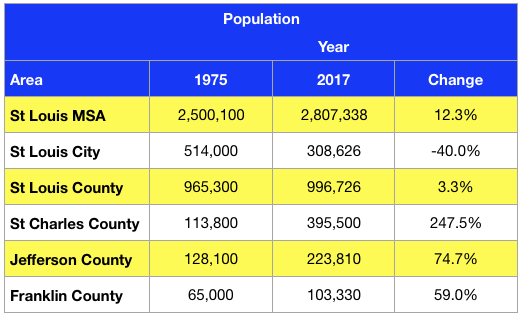
St Louis Population - 1975 - 2017


📬 Stay Ahead of the St Louis Market

Get local real estate updates, trends & insights — as soon as they publish.

Homeowners, buyers, investors & agents rely on us for what really matters in STL real estate.

We don’t spam! Read our privacy policy for more info.

📬 Want St Louis real estate updates as they drop?

Comments are closed.

St Louis Real Estate Search®         St Louis Home Values

St. Louis Real Estate News        Contact Us

Copyright © 2026 Missouri Online Real Estate, Inc. - All Rights Reserved
St Louis Real Estate News is a Trademark of Missouri Online Real Estate, Inc.

Missouri Online Real Estate, Inc. 3636 South Geyer Road - Suite 100, St Louis, MO 63127 314-414-6000 - Licensed Real Estate Broker in Missouri

The owner and authors this site are providing the information on this web site for general informational purposes only and make no representations, warranties (expressed or implied) or guarantees of any kind whatsoever, as to the accuracy or completeness of any information on this site or of any information found by following any link on this site. Furthermore, the owner and authors of this site will not be liable in any manner whatsoever for any errors or omissions in information on this site, nor for the availability of this information. Additionally the owner and authors of this site will not be liable for for any losses, injuries or damages in any way from the display or use of this information or as the result of following external links displayed on this site, or by responding to advertisements displayed, or contained, on this site In using this site, users acknowledge and agree that the information on this site does not constitute the provision of legal advice, tax advice, accounting services, investment advice, or professional consulting of any kind nor should it be construed as such. The information provided herein should not be used as a substitute for consultation with professional tax, accounting, legal, or other competent advisers. Before making any decision or taking any action on this information, you should consult a qualified professional adviser to whom you have provided all of the facts applicable to your particular situation or question. None of the tax information on this web site is intended to be used nor can it be used by any taxpayer, for the purpose of avoiding penalties that may be imposed on the taxpayer.
All of the information on this site is provided as is, with no assurance or guarantee of completeness, accuracy, or timeliness of the information, and without warranty of any kind, express or implied, including but not limited to warranties of performance, merchantability, and fitness for a particular purpose.
This site contains external links to other sites not owned or controlled by the owner of this site, therefore the owner of this site does not control or guarantee in any manner the accuracy or relevancy of any information obtained through following such links. Links contained on this site are for users convenience and users should exercise extreme caution when following links. Including a link on this site does not constitute an endorsement of the site linked to or any views or opinions expressed on the site, products or services offered on outside sites or the companies or organizations that own and operate outside sites.
This site may accept payment for advertising, for displaying advertisements, through affiliate relationships with companies or may receive referral fees or commissions from companies as a result of recommending or referring people to a website. This site may also accept free product samples, free services, gift cards or cash to review a product or service. All paid and sponsored content may not always be identified as such. Any product claim, quote or other representation about a product or service should be verified with the manufacturer or provider.

Where St Louis Area Homeowners Are Moving

By , on May 17th, 2018

The St Louis metro area has seen some population growth over the last few decades but not nearly as much as many other areas.  From 1975 until last year, the population of the St Louis MSA increased 12.3% from 2,500,100 in 1975 to 2,807,338 in 2017.  Of the major counties in Missouri that make up the St Louis MSA, St Charles County gained the most population increasing 248% during the same period.  As the table below shows, 4 of the 5 major counties covered saw an increase in population from 1975 to 2017, although St Louis County’s increase was a rather lackluster 3.3%.  Even St Louis County’s modest increase looks good when compared with the city of St Louis that lost 40% of its population during the period.

City of St Louis’ loss is St Charles County gain…

As the table below illustrates, St Charles County gained 281,700 people from 1975 through 2017 while the city of St Louis lost 205,474.  Granted, not everyone that left the city of St Louis moved to St Charles County, but there is a lot of “shuffling of the population” that occurs here with movement from one area to another within St Louis as the population shifts.  As a result, we end up with things such as the triple-digit increase in population in St Charles County and the city of St Louis losing nearly half of its population, while the overall metro area just had a modest gain.

How we compare to others…

To see how St Louis fared with other similar-sized areas, I checked the population history for the Davidson County Tennessee (Nashville) and Mecklenburg County North Carolina (Charlotte).  Below is what I found:

So, while smaller, St Charles, Jefferson, and Franklin County’s population growth outpaced Davidson County and just St Charles County managed to outperform Mecklenburg County.

In the coming days, I’ll take a look at how population change has affected home prices and sales.

(We work hard on this and sure would appreciate a “Like”)[iframe http://www.facebook.com/plugins/like.php?href=https%3A%2F%2Fwww.facebook.com%2FStLouisRealEstateNews&send=false&layout=standard&width=50&show_faces=false&font&colorscheme=light&action=like&height=35&appId=537283152977556 100 35 ]

St Louis Population – 1975 – 2017

(click on the table below for live charts showing complete data for each area)

St Louis Population - 1975 - 2017

Search St Louis Homes For Sale    Search St Louis Upcoming OPEN HOUSES


Comments are closed.