 It’s hard to miss the fact that the US Census Bureau just released some of the results of the 2010 census for our area. It’s been all over the media about St. Charles County’s population surpassing the City of St. Louis and moving it into the spot of the third largest county in the State.
Being the data junkie I’ve become I decided to tear into the numbers and see how the 2010 data compared with the 2000 data to see what changes have taken place in the last decade and see what I could glean from the data to perhaps get a little insight on the impact of these changes on the St. Louis real estate market. Also, since I have been somewhat of a contrarian in saying the that reports of low housing starts is a good thing as I don’t think we need to add housing units in this market, I thought it would make sense to see if my theory holds water.
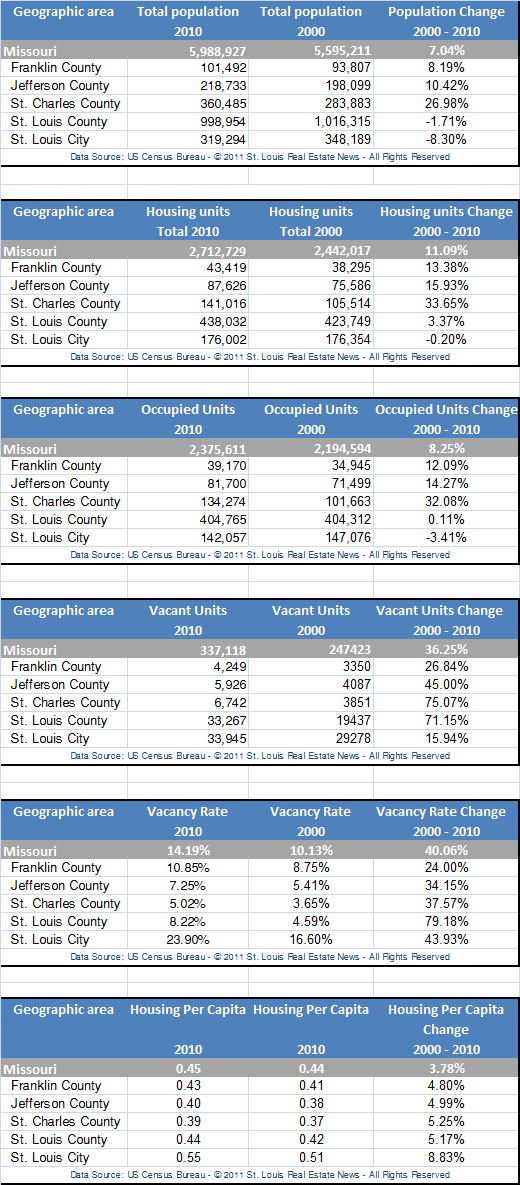
As I typically do, I focused on the five-county area that makes up most of the St. Louis area real estate market I talk most about, but then also included data for the entire state of Missouri as well. Below are all the pretty tables of data I put together, and they are pretty self-explanatory but I’ll highlight some of the findings:
- Population Change – Missouri had population growth of 7.04 percent from 2000 – 2010
- Three of the five counties had population increases with St. Charles County leading the way with 26.98% population growth. The City of St. Louis and St. Louis County both lost population during the period, 8.3 percent and 1.71 percent respectively.
- Housing Units – Missouri had an increase of 11.09 percent in housing units from 2000-2010
- Four of the five counties had an increase in housing units (interestingly, all in excess of their population growth) with St. Charles County again leading the way at 33.65 percent. The city of St. Louis saw a very modest decline in housing units of 0.20 percent for the period.
- Vacancy Rates – Missouri has had an increase of 40.06 percent in the vacancy rate of housing units from 2000 – 2010.
- All five counties had double-digit increases in vacancy rates during the period with St. Louis county leading the way with a whopping 79.18 percent increase followed by the city of St. Louis with a 43.93 percent increase in vacancy rate.
- Housing per capita – I decided to look at the relationship between the number of housing units and the population as well as the change from 2000 to 2010. The State of Missouri had a 3.78 percent increase in housing units per capita during the period going from 0.44 housing units per person in 2000 to 0.45 housing units per person in 2010.
- All five counties saw an increase in housing units per capita and all at rates higher than the State of Missouri as a whole. The City of St. Louis had an increase of 8.83 percent going from 0.51 housing units per person in 2000 to 0.55 per person in 2010.
In reviewing the data above, here are my “off the cuff” remarks;
- I think it is clear, that in addition to the effect the economy has had on the St. Louis housing market, another contributing factor to our problems here are a result of our lackluster population growth. While St. Charles, Jefferson and Franklin Counties all saw growth during the period, St. Louis City and County both lost population.
- In looking at how the growth of housing units is outpacing the growth in population for the State as a whole as well as the five counties I’ve covered, including those counties with significant growth such as St. Charles, I think my prior comments about over-building are accurate. Clearly, even with sickening low numbers of new homes being constructed, it still appears there is still over-building going on. If you still don’t believe me, look again at the chart showing vacancy rates and the number of vacant housing units….even St. Charles County with it’s almost 27 percent population growth for the decade has 75 percent more housing units vacant in 2010 than a decade before.
If our region and state could attract more business and jobs to our region then we will see population growth. Jobs and population growth will help the St. Louis housing market, vacancy rates will fall and there will be demand for new homes. The problem is how do we do this? Missouri hasn’t really seen businesses (and jobs) flocking to it in the past decade. So what will change it? Eliminating state income tax? Becoming a right to work state? Both? Hmm…


Leave a Reply
You must be logged in to post a comment.