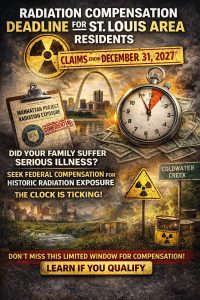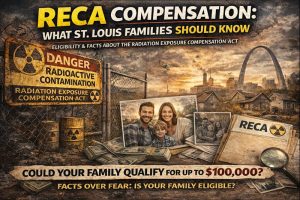
You may have seen recent news about the federal Radiation Exposure Compensation Act, often referred to as RECA. For many St. Louis–area families, this is not an abstract policy discussion. It is personal.
The challenge is that most people do not know what the law actually covers, who it applies to, or whether it is worth looking into at all. This article is not about fear, speculation, or legal advice. It is about practical, factual guidance.
What RECA is and what it is not
The Radiation Exposure Compensation Act is a federal compensation program, first enacted in 1990, that provides one-time payments to individuals who developed specific illnesses after documented exposure to radiation tied to U.S. government nuclear weapons activities.
It does not:
-
Declare neighborhoods unsafe to live in
-
Automatically qualify entire communities
-
Replace medical or environmental remediation programs
-
Provide ongoing payments
It does provide compensation to individuals who meet very specific eligibility criteria related to exposure history, diagnosis, and documentation.
Why this matters locally
St. Louis has a unique and well-documented history connected to early nuclear weapons development, including radioactive waste generated during the Manhattan Project era. That history has led to decades of environmental study, cleanup efforts, and community advocacy.
Recent federal action has renewed and expanded the RECA program, making it relevant again for families who previously assumed the window had closed or that Missouri residents were not included.
That does not mean everyone qualifies. It does mean some people who never considered this before may now be eligible to apply.
Who should consider looking into RECA
You may want to explore RECA eligibility if all three of the following apply:
-
You or a close family member lived, worked, or spent significant time in affected areas during past decades connected to known radioactive waste or uranium processing activities.
-
You or that family member has been diagnosed with a condition specifically listed under the RECA statute.
-
The exposure occurred during time periods recognized by the federal program.
RECA is diagnosis-specific and exposure-specific. Simply living in the St. Louis area is not enough on its own, and many illnesses are not covered under the law.
What conditions are considered
The law includes a defined list of cancers and serious illnesses. Eligibility is based on medical diagnosis, not symptoms or suspected exposure alone. Documentation matters.
This is one of the most common misunderstandings: RECA is not a general health claim program. It is a narrowly defined compensation statute.
What the application process actually looks like
RECA claims are administered by the U.S. Department of Justice. Applicants must submit:
-
Proof of diagnosis
-
Proof of residence, employment, or presence in covered areas during eligible periods
-
Supporting documentation that meets federal standards
There is no automatic approval, and applications can be denied if documentation is incomplete or eligibility criteria are not met.
That said, community organizations and legal aid groups have emerged to help residents understand the process and avoid common mistakes.
What homeowners and families should keep in perspective
This law is about individual compensation, not property values or real estate disclosures. RECA does not change how homes are bought or sold in St. Louis, nor does it designate new contamination zones.
For homeowners, the most important takeaway is informational, not transactional: understanding family history, records, and potential eligibility.
A realistic next step
If you believe your family may qualify, the most practical first step is gathering documentation, not filing immediately. That includes:
-
Old addresses
-
Employment records
-
Medical records
-
Dates and durations of residence or work
From there, speaking with a qualified professional or trusted advocacy organization can help determine whether a formal application makes sense.
The bottom line
The renewed attention on the Radiation Exposure Compensation Act does not mean everyone should panic, and it does not mean everyone qualifies.
What it does mean is that some St. Louis–area residents who were previously excluded or unaware may now have a path to compensation, and ignoring that possibility entirely may not be in their best interest.
As with many things tied to our region’s history, the key is separating facts from assumptions and understanding what applies to your situation — and what does not.
📲 Contact me today to put a plan in motion — and let’s make your next move your smartest one yet.
Karen Moeller
Karen.Moeller@stlre.com
314.678.7866
Connect with Karen Moeller