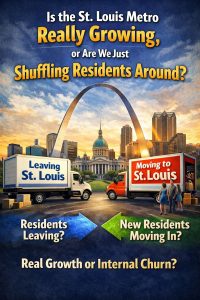
Recent U.S. Census data confirmed that the St. Louis metro added population last year.
But the bigger question clients keep asking me is this: are we actually growing, or are people simply moving around inside the region?
For years, the St. Louis region has worn a familiar label. Flat. Stagnant. Losing people.
So when a client recently asked me a deceptively simple question, it stopped me in my tracks.
Is Greater St. Louis actually growing, or are people just moving from one municipality to another inside the same metro?
It is a fair question. It is also a more important one than it might seem.
Because if growth is real, that changes how we think about housing demand, school enrollment, infrastructure, and long term investment. If it is only internal churn, the implications are very different.
Here is what the data says, and what it really means for our market.
The Headline Answer: The Metro Is Growing, Modestly and Measurably
The latest U.S. Census Bureau estimates show that the St. Louis Metropolitan Statistical Area gained roughly 6,400 residents between mid 2023 and mid 2024, marking the strongest annual increase the region has seen in more than a decade.
That is not explosive growth. But it is meaningful.
It tells us this is not just Brentwood trading residents with Webster Groves or Kirkwood trading households with Chesterfield. The region as a whole added people.
That distinction matters.
City Versus Suburbs: Two Very Different Stories
The growth is not evenly distributed.
The City of St. Louis continues to lose population, a long running trend driven by an aging housing stock, smaller household sizes, and limited new construction at scale.
At the same time, much of the region’s net growth is landing in the suburbs and exurbs, particularly in West St. Louis County and parts of St. Charles County, where buyers find a combination of newer housing, school choice, employment access, and relative affordability.
So while the city may be shrinking, the metro is not. And that means this is not simply a shell game of residents moving across municipal borders. There is genuine in migration happening.
Where the New Residents Are Coming From
Three forces are doing the heavy lifting.
1. International Migration
St. Louis is quietly becoming a stronger destination for immigrants and international households. Census data shows that international migration is now one of the primary drivers of the region’s population growth.
Without it, the metro would likely still be shrinking.
This matters for housing because international migration creates entirely new households, not just moves within the region.
2. Domestic Migration Driven by Affordability
Compared to coastal and Sun Belt markets that have become prohibitively expensive, St. Louis offers a compelling value story. Buyers relocating from higher cost metros can often purchase larger homes, live closer to work, and reduce overall cost of living without sacrificing amenities.
This is not theoretical. In my own practice, I routinely work with buyers coming from Chicago, the East Coast, and the Mountain West who are actively choosing St. Louis for quality of life and financial reasons.
3. Demographic Reality: Births No Longer Drive Growth
Like much of the Midwest, St. Louis now sees more deaths than births each year. That means population growth no longer comes from natural increase. It comes almost entirely from migration.
In other words, if people stop moving here, growth stops.
That makes every inbound household economically meaningful.
What National Buyer Trends Tell Us About Local Growth
The 2025 National Association of Realtors Profile of Home Buyers and Sellers adds important context to this story.
Nationally, first time buyers now make up only 21 percent of the market, the lowest share in decades. The median age of a first time buyer is 40. Repeat buyers are now typically in their early 60s.
What does that mean for St. Louis?
It suggests two things.
First, many local moves are internal churn. Empty nesters downsizing, move up buyers relocating within the same county, and retirees shifting housing types without leaving the region.
Second, real growth comes from younger households and inbound migrants who are forming new households here, not just reshuffling existing ones.
When St. Louis captures those buyers, the metro grows. When it does not, the market simply recycles the same population.
Why This Matters for Housing and Community Planning
This is not an abstract demographic exercise. It has real consequences.
If growth is real, even at a modest pace, then:
- Housing demand stays resilient despite higher interest rates
- School districts that attract in migration remain stable or grow
- Infrastructure and zoning decisions become long term economic strategy, not just planning exercises
- Communities that allow housing diversity capture more of that growth
If growth were only internal shuffling, then we would expect declining household formation, weakening long term demand, and increasing competition between municipalities for the same residents.
The data suggests we are in the first scenario, cautiously and deliberately.
A Local Lens: What This Means for Communities Like Kirkwood
Kirkwood is a perfect micro example.
Much of the market activity here is internal churn. Families move up within the district. Empty nesters downsize nearby. Builders replace older housing with new infill.
But the reason that churn remains healthy is because new households are entering the region and choosing communities like Kirkwood.
When the metro grows, strong communities benefit disproportionately.
That is why understanding regional population trends is not just academic. It is directly tied to home values, school stability, and long term community vitality.
The Bottom Line
The St. Louis metro is not booming. But it is growing.
And that growth is not simply people sliding across municipal lines. It is driven by real migration, new households, and long term demographic shifts that will shape our housing market for years to come.
For buyers, sellers, investors, and community leaders, that is not just good news. It is actionable intelligence.

Karen Moeller
🌐 STLKaren.com
📧 Karen.McNeill@STLRE.com
📞 314.678.7866
About the Author:
Karen Moeller is a St. Louis area REALTOR® with MORE, REALTORS® and a regular contributor to St. Louis Real Estate News, helping clients make informed, data-driven decisions.