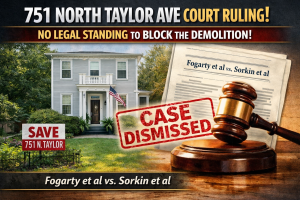
But look a little closer and you are looking at something rare. The house is believed to date back to around 1858, making it one of the oldest surviving residences in Kirkwood and one of the few homes in the area that predates the Civil War. A demolition permit has been filed, and the property is currently moving through the City’s review process, with a key deadline approaching in late February. For a community known for its historic character, the possible loss of a home like this is not a small thing. It is a piece of the story.
When you pass a house often enough, you start to notice the small things. The proportions. The roofline. The way it settles into the lot like it has always belonged there. Over time, it feels less like just another structure and more like part of the street’s memory. That quiet familiarity is exactly what makes it significant.
A surviving piece of early Kirkwood
Historical records suggest the home was standing by the late 1850s. One early owner, William Marquitz, operated a grocery on what is now Kirkwood Road and had settled in the area by 1870. Families like his helped shape the earliest days of the town’s commercial and residential life.
Architecturally, the house reflects Italianate influences that were popular in the mid to late nineteenth century. The low pitched roof, pronounced cornice, and tall windows are hallmarks of the style. While additions were made in the early 1900s, much of the main structure remains intact. That kind of authenticity is difficult to recreate. You can build something new that looks old. You cannot reproduce 160 years of lived history.
Homes from this era were often constructed with materials and methods that are rarely seen today. Old-growth lumber, harvested from slower-growing trees, tended to be denser, straighter, and more stable. Combined with traditional craftsmanship, it produced structures that have already proven their durability by standing for well over a century. That longevity is not accidental. It is one reason so many nineteenth- and early twentieth-century homes remain solid long after newer buildings have required major repairs or replacement. Preservation is not only about charm or nostalgia. In many cases, it is also about recognizing the value of construction that was designed to endure.
More than aesthetics
Beyond materials and craftsmanship, homes like this give a neighborhood depth.
When you walk through older parts of Kirkwood, Webster Groves, or other historic St. Louis suburbs, you feel layers of time. Different eras sitting side by side. A mix of styles that tells the story of how the community evolved. That variety is what makes these neighborhoods feel like Kirkwood, not Anywhere, USA. When a truly historic structure disappears, that depth shrinks a little. Streets become more uniform. A little less textured. A little less tied to their own past. It is not about freezing a place in time. Cities evolve, and they should. But thoughtful growth usually means deciding which pieces of history are worth carrying forward.
Questions around condition
Concerns have been raised publicly about potential asbestos. It is worth noting that a house built in the 1850s would predate the widespread use of asbestos in American construction. While later renovations could introduce materials from the mid twentieth century, asbestos issues are far more commonly associated with homes built decades after this one. Like any older property, repairs and updates may be needed. But demolition is a permanent solution to what is often a manageable problem. Once the structure is gone, there is no bringing it back
A local decision with broader impact
At one level, this is a private property and a personal decision for an owner. At another, homes like this help shape the identity of an entire community.
For many neighbors, it’s not just an aging structure. It’s a familiar landmark and a quiet reminder of how long this street has existed and how many lives have passed through it. Pre-Civil War buildings aren’t simply old houses. They’re physical links to the earliest chapters of our region, and once they’re gone, that history can’t be rebuilt.
Kirkwood is a walking town. Every day, people pass this house without thinking twice. It’s worth slowing down for a moment and really seeing it. Homes like this don’t come around often, and once they’re gone, they don’t come back.

Karen Moeller
🌐 STLKaren.com
📧 Karen.McNeill@STLRE.com
📞 314.678.7866
About the Author:
Karen Moeller is a St. Louis area REALTOR® with MORE, REALTORS® and a regular contributor to St. Louis Real Estate News, helping clients make informed, data-driven decisions.