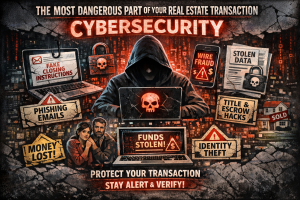
We spend a lot of time talking about inspections, pricing strategies, and market timing, but the biggest financial risk in a real estate transaction today often has nothing to do with the property itself. It happens quietly, and by the time most people realize what’s going on, it’s already too late.
It’s cybercrime.
According to the Federal Bureau of Investigation’s latest Internet Crime Report, Americans lost more than $16 billion to cybercrime in 2024, a 33 percent increase from the year before. Real estate is not a small piece of that problem. It is one of the most targeted.
Why Real Estate Is Such an Easy Target
Real estate transactions have all the ingredients scammers look for: large sums of money moving quickly between multiple parties, often through email. The most common attack is business email compromise. It sounds technical, but the execution is simple.
A scammer inserts themselves into a transaction by gaining access to, or convincingly imitating, a trusted email account. Then, at just the right moment, they send updated wiring instructions.
Everything looks normal, the timing makes sense, and the request feels routine. That’s exactly why it works.
The FBI continues to report billions of dollars lost each year to these types of scams, with real estate transactions being a consistent target because of how quickly funds move and how much trust is placed on email communication.
The Part Most People Don’t See Coming
What makes this especially dangerous is not just the technology. It’s the psychology. These scams don’t rely on obvious red flags anymore. They rely on familiarity.
You may see an email that appears to come from your agent or title company, a message that references your actual transaction details, or instructions that arrive at exactly the moment you expect them. That is not an accident. That is the strategy. And despite how common this has become, many buyers and sellers are still not fully aware of the risk until they are already in the middle of a transaction.
Where St. Louis Buyers and Sellers Are Most Vulnerable
The highest-risk moment is right before closing. Emotions are high, deadlines are real, and funds are about to move. At the same time, last-minute communication feels normal, which is exactly what makes it dangerous. Whether you are closing in Kirkwood, Spanish Lake, Wildwood or anywhere across the St. Louis area, the mechanics are the same. Which means the risk is too.
What Actually Prevents This
This is one of the few areas in real estate where the solution is straightforward, but only if people take it seriously. It is not enough to trust wiring instructions sent by email, even if it looks like it came from someone you know.
Verify. Verify. Verify.
Always confirm wiring instructions using a known, trusted phone number. Not a number in the email, but one you already have or independently verify. Be cautious with last-minute changes. Urgency is often the signal that something is off. And when money is involved, slow the process down. Legitimate parties will never have an issue with you double-checking.
If Something Feels Off, It Probably Is
One of the most important things to understand is how quickly these situations move. Once funds are wired, they can be transferred again within minutes. That is why early detection matters.
The FBI has had success freezing fraudulent transfers when victims report them immediately, sometimes recovering funds in time. But that window is very small. Hesitation helps you before you send the wire. Speed helps you if something goes wrong.
Why This Matters More Now
Cybercrime is not just increasing in frequency. It is increasing in impact. More people are losing money, and the amounts they are losing are higher. This is not because people are careless. It is because the scams are getting better. Real estate transactions remain one of the most efficient ways for bad actors to access large amounts of money quickly.
The Bottom Line
You can do everything right in a transaction and still be exposed to risk if this part is overlooked. Cybersecurity is now part of the real estate process. Not a fringe issue or a “just in case.” It is a standard part of protecting your investment.
If you are buying or selling in the St. Louis area, this is one of those details that deserves real attention. I walk my clients through exactly how funds move, where risk exists, and what to look for before anything is sent. Because getting to the closing table is only a win if your money gets there too.

Karen Moeller
STLKaren.com
Karen.McNeill@STLRE.com
314.678.7866
About the Author:
Karen Moeller is a St. Louis area REALTOR® with MORE, REALTORS® and a regular contributor to St. Louis Real Estate News, helping clients make informed, data-driven decisions.




azitrox
azitrox
lamictal for bipolar
lamictal for bipolar
50mg sildenafil review
50mg sildenafil review
minoxidil price costco
minoxidil price costco
sildenafil viagra contraindications
sildenafil viagra contraindications
cialis heart health
cialis heart health
doxycycline 100mg for acne
doxycycline 100mg for acne
sandoz sildenafil 100mg review
sandoz sildenafil 100mg review
acyclovir safe when breastfeeding
acyclovir safe when breastfeeding
ivermectin safety medical insights
ivermectin safety medical insights
minoxidil 2% vs 5% detailed comparison
minoxidil 2% vs 5% detailed comparison
sildenafil food‑related onset changes
sildenafil food‑related onset changes
vardenafil side effect notes
vardenafil side effect notes
Food and Sildenafil Absorption
Food and Sildenafil Absorption
Educational Alcohol Interaction Resource
Educational Alcohol Interaction Resource