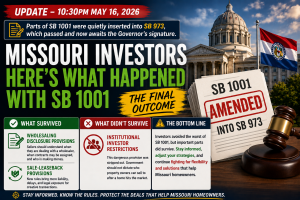
UPDATE – 10:30pm May 16, 2026
The wholesaling disclosure provisions survived, and honestly, I’m generally okay with that part. Sellers should understand when they are dealing with a wholesaler, when contracts may be assigned, and who is making money on the deal.
The good news for investors is the institutional investor restrictions appear to have been stripped out before final passage. In my opinion, that was by far one of the dumbest and most dangerous parts of the original bill because government should not be telling property owners who they are allowed to sell to after a house has been exposed to the market.
Unfortunately, the sale-leaseback provisions also survived, and that is the part I strongly disagree with. While there absolutely have been abusive situations nationally, these new rules create major liability, delays, and legal exposure for transactions that are often used to help distressed homeowners who need speed, flexibility, or creative solutions that traditional financing simply cannot provide.
Missouri real estate investors, wholesalers, and creative deal makers got a major break this week as Senate Bill 1001 officially died when the Missouri legislative session ended last night without final passage. After months of discussion, concern, lobbying, and speculation throughout the real estate and investor community, it now appears that none of the major provisions I wrote about earlier this year involving wholesaling disclosures, sale-leaseback restrictions, mandatory waiting periods, or the proposed civil penalties actually made it into Missouri law. While it will still take a few days for everyone to fully dissect final bill language from the session and confirm nothing was quietly inserted into another bill that passed, at this point all indications are that SB 1001 is effectively dead for this session, and that is a very significant development for investors throughout Missouri and particularly here in the St. Louis market where wholesaling, assignments, creative financing, and distressed property investing are all very active parts of the real estate ecosystem.
Had this bill passed in its perfected form, it would have represented one of the biggest government crackdowns Missouri has ever attempted on creative real estate transactions. The wholesaling provisions alone would have fundamentally changed how many assignment deals operate by requiring wholesalers to provide written disclosures to sellers at least 14 days before entering into a contract, specifically warning the seller that the buyer intended to potentially assign the contract for profit and was not acting in the seller’s interest. On paper, some people probably read that and thought it sounded harmless enough, but in reality that type of requirement would have dramatically altered the timing, structure, and practicality of many investor transactions, particularly distressed property deals where speed and flexibility are often the entire reason the seller is willing to work with an investor in the first place. In many cases these are not traditional retail sellers putting a perfectly updated home on the open market and waiting for the highest bid. These are inherited homes, distressed situations, homes needing major repairs, foreclosure situations, tax issues, probate situations, landlords wanting out quickly, or sellers who simply value certainty and speed over maximizing price.
The sale-leaseback provisions in the bill were even more aggressive and honestly would have scared a lot of legitimate investors away from those transactions altogether. Under SB 1001, buyers in sale-leaseback transactions would have been required to provide extensive disclosures warning sellers they were giving up ownership rights, could face eviction later, could lose repurchase opportunities, and should consult attorneys, tax advisors, housing counselors, real estate agents, and appraisers before proceeding. On top of that, the bill imposed a mandatory 30-day waiting period before closing along with civil penalties of up to $10,000 per violation plus potential lawsuits and attorney fees. There is no question lawmakers were trying to target situations they believed were abusive or predatory, and to be fair, there absolutely have been some ugly situations nationally involving homeowners who did not fully understand what they were signing in certain creative financing or sale-leaseback transactions. Some investors absolutely push ethical boundaries, and there are bad actors in every business, including real estate investing.
At the same time though, what legislators often fail to fully appreciate is that many of these transactions exist because conventional solutions are not available to these sellers in the first place. Banks are not lining up to finance distressed houses needing massive repairs. Traditional buyers often cannot close quickly enough. Many homeowners facing financial pressure, probate issues, title issues, deferred maintenance, or foreclosure simply need fast and flexible options that traditional real estate channels do not provide. When government regulations add too much liability, too many timing restrictions, and too much uncertainty, legitimate investors often stop offering those solutions entirely because the legal exposure and delays no longer justify the risk. The result is not necessarily better outcomes for distressed sellers. Sometimes it simply means fewer available options and fewer buyers willing to step into difficult situations.
From my perspective, the most important takeaway here is not simply that SB 1001 died, but that Missouri lawmakers are now clearly paying attention to wholesaling, sale-leasebacks, and creative real estate transactions in a way they really have not before. This bill did not come out of nowhere. Nationally there has been increasing political and regulatory pressure surrounding institutional investors, wholesaling practices, private equity ownership of homes, foreclosure rescue transactions, and creative financing arrangements. Missouri was obviously beginning to move in that same direction. Even though this bill failed, I would be very surprised if some version of these ideas does not come back in future legislative sessions, perhaps rewritten, narrowed, or attached to different legislation that may have a better chance of passing.
So while investors probably won this round, I do not think anyone involved in wholesaling or creative deal structuring should assume the scrutiny is going away. If anything, the failed bill should probably serve as a warning shot that lawmakers, regulators, and consumer advocates are watching these transactions more closely than ever before. Investors who operate professionally, disclose clearly, document carefully, and avoid questionable practices will probably be in the best position going forward because eventually one of these bills may very well cross the finish line.