For years we’ve heard plenty of talk about America’s housing affordability problem, but most of the proposed solutions seem to come down to some version of the same thing: lower interest rates, loosen zoning, subsidize buyers or somehow convince traditional homebuilders to build less expensive homes. A relatively new company in Austin, Texas, is taking a very different approach. The American Housing Corporation is trying to reinvent how the house itself is built.
What caught my attention is that this isn’t simply another modular-home manufacturer. American Housing is attempting to combine real estate development, manufacturing, software and engineering into one vertically integrated company, borrowing some of the same thinking its founder saw firsthand at SpaceX. The company was founded in 2024 by Riley Meik, Bobby Fijan, Harris Rothaermel and William Davis. Meik, the CEO, has a background in mechanical engineering and aerospace and previously worked at SpaceX on the Starship program. The other founders bring backgrounds in real estate development, manufacturing, aerospace and software engineering.
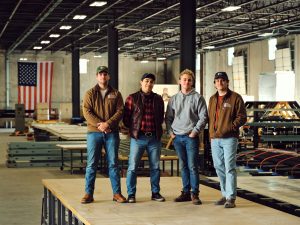
Founders: Riley Meik, Bobby Fijan, Harris Rothaermel, Will Davis
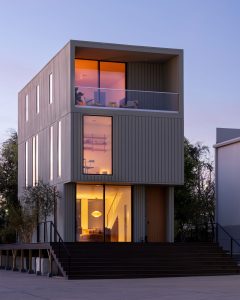
Photo Credit: Bryson Malone
Instead of building most of the house conventionally at the job site, American Housing manufactures major building components in its Austin factory using a proprietary kit-of-parts system. Those components are designed to fit into ordinary intermodal shipping containers, be transported to the development site and then assembled quickly using standardized connections and processes. The company says its rowhomes can be assembled onsite in days.
This is also an important distinction for buyers: these are not mobile homes or HUD-code manufactured homes.According to American Housing, the homes are permanently installed, meet conventional building codes and are classified as conventional real estate for financing and ownership purposes. The company is starting with attached rowhomes because it believes they offer one of the best ways to produce family-sized housing in desirable neighborhoods without requiring the amount of land needed for traditional detached subdivisions.
That concept certainly isn’t new. Anyone familiar with older neighborhoods in St. Louis, Philadelphia, Baltimore, Chicago or Boston knows that attached and closely spaced homes were once a very normal way to create relatively affordable housing in great neighborhoods. What is new is the way American Housing proposes to build them. The company manufactures major components in its own factories using custom machinery, then ties land underwriting, site planning, factory production and onsite assembly together through its software platform called Alamo. The whole concept of panelized construction is not new either, back in the 1980’s the first new home development I built was done utilizing panelized construction from National Building Systems. The difference is, those panels were replicas of what was built by hand in the field with the only difference being the pre-assembly in a factory type environment whereas American Housing’s concept is totally new.
In other words, they aren’t just trying to manufacture a cheaper wall panel. They are trying to industrialize virtually the entire development process, and that is what makes this interesting to me. American Housing says its process can significantly reduce both construction costs and the amount of labor required onsite. Meik has said that once the components arrive at the site, their system requires roughly one-tenth the onsite labor hours of conventional construction. He has also suggested that their homes may ultimately be produced at dramatically lower costs than comparable traditionally constructed homes.
Those are impressive claims, but they are still claims. This is a young company. It has built prototypes and opened its first Austin factory in 2025, but it has not yet built thousands of houses across the country and demonstrated those savings over and over again. So I wouldn’t take a projected 30% or 50% construction-cost reduction and automatically translate that into a house selling for 30% or 50% less.
Land still costs money. Development costs money. Municipal approvals, utilities, financing, taxes and infrastructure all cost money. And ultimately houses are going to be priced in the market in which they are located. Still, if you can substantially reduce the cost and time required to physically produce the house, you’ve attacked one very large part of the affordability equation.
American Housing isn’t thinking small. Its headquarters and first factory are in Austin, but the company says it already has projects in development in Texas, New Mexico, California, Washington and Montana. The first collection of homes is currently being developed and, when completed, the homes will be offered for either purchase or rent. The company is not currently accepting orders for individual custom homes. The company also works with landowners and developers through joint ventures, which could allow the concept to expand into additional markets without American Housing having to acquire every development site itself.
Could St. Louis eventually be one of those markets? There is nothing from the company indicating that St. Louis is currently in its pipeline, so I don’t want to suggest that it is. But conceptually, St. Louis might be an interesting fit for this type of housing. We have countless established communities with existing streets, infrastructure, employment centers and amenities. We also have vacant or underutilized parcels where adding relatively dense, attractive, family-sized ownership housing could make considerably more sense than trying to recreate the large-lot suburban subdivision model.
And culturally, the rowhouse isn’t exactly foreign to St. Louis. We built plenty of beautiful attached and narrow-lot housing long before anybody decided to call it “missing middle housing.” I have personally developed several townhome developments in St Louis over the years and they were received well by the market.
For a home buyer, however, the bigger question isn’t whether the construction method sounds innovative. It’s what kind of home do I get, where is it located and what does it cost? If American Housing can produce an attractive, durable, conventionally financed home in a desirable neighborhood for substantially less than it costs a traditional builder to produce the same home, buyers really won’t care whether parts of their house arrived on a truck from a factory.
In fact, factory production could eventually be viewed as an advantage. We don’t assume that a car built inside a modern factory is inferior to one someone assembled in our driveway. Controlled manufacturing can potentially mean tighter tolerances, better quality control, less weather exposure during construction and more consistency from one house to another. Whether American Housing can deliver all of that at scale remains to be seen, but I like the question they’re asking.
Instead of asking how do we help people afford increasingly expensive houses, they’re asking why does it cost so much to build the house in the first place? That’s a question the housing industry could probably stand to ask a little more often.
American Housing describes its goal as producing attractive starter homes in dynamic American cities and neighborhoods. Its current projects in Texas, New Mexico, California, Washington and Montana should give us the first real evidence of whether this approach works outside a prototype factory.
I’ll be watching this one, because if they can actually deliver good-looking, durable homes that buyers want, in good neighborhoods, while materially reducing construction costs, they may have something much more significant than another prefab housing concept. They may have figured out a better way to build houses.