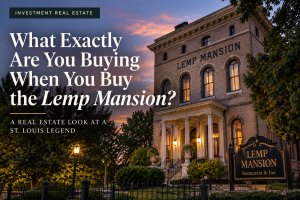
Other than my own home, there aren’t many houses where I’ve spent more time than the Lemp Mansion. Long before I became a Realtor, I was an actress, and one of my regular weekend gigs was performing dinner theater there.
Years ago, some visitors posed for a photograph in front of the staircase. When they looked at the picture later, they noticed what appeared to be an elderly woman in period clothing near the top. The photo eventually appeared on social media with quite a discovery: They had photographed a ghost.
Which would have been pretty exciting, except I knew the ghost. Her name was Angie, and she was an actress waiting for her cue.
Stories like that are part of what I remember about working at the Lemp. I knew the Mansion not just as a historic house or a supposedly haunted one, but as a workplace. Now it’s for sale for $3.9 million, and I’m looking at the same building as a Realtor. That changes the questions.
I remember the two radiators warming you as you came through the front door on a winter night, the painted-cloud ceiling in one of the dining rooms, and a third-floor dressing room where members of the “Ghost Hunters” television crew once unexpectedly walked in carrying equipment I couldn’t begin to identify. Let me tell you, nothing makes you wish you could transport yourself through a wall faster than standing half-dressed in front of a television crew you weren’t expecting.
But the question I find myself asking now isn’t whether the Lemp Mansion is haunted. It’s this: What exactly are you buying when you buy the Lemp Mansion? On paper, that question is easy to answer. According to the listing agent, $3.9 million buys the Mansion, grounds and carriage house, along with the furnishings, equipment and restaurant items. But the Lemp Mansion comes with quite a bit that won’t appear on a bill of sale.
I knew the result from the inside. Dinner guests generally remained downstairs, while the upper floors were primarily the territory of inn guests, actors and staff. On particularly busy nights, I would perch on an antique couch near the staircase, watching several dining rooms and pacing my entrances while trying to stay out of the way of servers. Guests walking past would occasionally make it their mission to get me to break character.
My dressing room was on the third floor in a space that felt more like an unfinished attic, shared with supplies and a furnace. A narrow back staircase wound from floor to floor and eventually took us down to the basement and kitchen.
Tucked toward the back of the building was one of my favorite places, the Lemp Museum. Its curator, Marcia Stamm, knew an astonishing amount about the Lemps and St. Louis brewing history. Between acts, I would wander back there and pepper her with questions about the Lemp, Falstaff and Griesedieck families and breweries.
History wasn’t confined to the museum. Portraits put faces to the people in the stories, and Lemp family artifacts and clothing were displayed throughout the house. One enormous walk-in vault, the kind of thing you expect in a bank rather than a private home, had been converted into the owners’ office. I later learned it was one of three large vaults the Lemp family had built to house an extensive art collection.
The tunnels were another part of the building that fascinated people, and they aren’t simply ghost lore. The Mansion’s history describes a natural cavern beneath the property containing an auditorium, ballroom and swimming pool, once accessible through a tunnel from the basement. Another tunnel connected the house with the brewery. Both are now sealed. When I worked there, a bar occupied what we understood to have been one of the old tunnel entrances.
All of those physical things belong to the property. What people have made of them over the years is harder to categorize.
I saw that firsthand during one performance when a woman became increasingly agitated. She was convinced spirits were in the room and eventually became disruptive enough that I broke character and asked if she was all right. She pointed toward ribbons hanging in front of the windows. They were moving, and she was certain the ghosts were upset.
I showed her that air coming through the window was moving the ribbons. Once she understood what she was seeing, she relaxed. I was perhaps less diplomatic than I would be today.
“Right, because if I were a 100-year-old ghost, I’d go to the window and wiggle a ribbon. I can think of a lot more interesting things to do if I were a ghost. Can’t you?”
One of the benefits of being an actor is that occasionally you can get away with acting out.
I’m not telling that story to prove the Lemp Mansion isn’t haunted, any more than I would offer someone else’s unexplained experience as proof that it is. Whether ghosts exist isn’t really the interesting real estate question. The fact that people believe they might be there is.
People have paid to investigate the Mansion for paranormal activity, stay overnight, hear its history and experience a place whose reputation extends far beyond its architecture. Whatever one believes about ghosts, those stories are part of the experience people associate with the Lemp Mansion.
That raises a slightly ridiculous but surprisingly legitimate question: Can ghosts be goodwill?
Not literally. Goodwill is a real concept in business valuation. The IRS defines it in terms of expected continued customer patronage tied to a business’s name, reputation or other factors. At the Lemp Mansion, it becomes difficult to figure out where the physical property stops and that intangible value begins.
The building itself offers a clue. A private home became a boarding house and eventually a place where people ate dinner, celebrated weddings, slept overnight, watched actors murder one another for entertainment and wandered around looking for people who had actually been dead for a century. Its survival has depended, at least in part, on people continuing to find reasons to come through the door.
When I sat on that antique couch waiting for my cue, I wasn’t thinking about historic preservation or adaptive reuse. I was watching dining rooms, trying to stay out of the servers’ way and wondering whether the guest approaching me was about to try to make me break character. I was just working, but it turned out to be a remarkably good seat from which to watch an old building earn its living.
Nearly 50 years ago, Richard Pointer bought a building that had become a boarding house and gave it another life. What the Pointer family created wasn’t simply a way to tour an old Lemp home. They made the house itself an experience, one where history, architecture, food, theater, celebrations and a healthy dose of ghost lore became difficult to separate from one another.
That’s what makes this sale so interesting to me. A buyer can purchase the Mansion, the grounds, the furniture and everything else included in the $3.9 million offering. What can’t be transferred quite so neatly is the experience people have come to associate with the place.
Without that, the Lemp Mansion is still an extraordinary historic house with an extraordinary St. Louis history. But is it still a destination?
For the next owner, that may be the more important question.

Karen Moeller
STLKaren.com
Karen.McNeill@STLRE.com
314.678.7866
About the Author:
Karen Moeller is a St. Louis area REALTOR® with MORE, REALTORS® and a regular contributor to St. Louis Real Estate News, helping clients make informed, data-driven decisions.