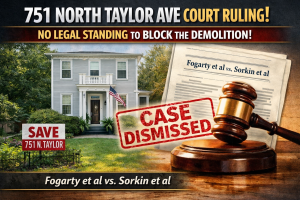
A recent court decision involving the historic home at 751 North Taylor Avenue in Kirkwood makes one thing very clear…just because people don’t like what a property owner is doing doesn’t mean they have the legal right to stop it.
The case, Fogarty et al vs. Sorkin et al, was filed by neighbors and others trying to block the demolition of the Marquitz-Garesche House, a home built in 1858 and located in Kirkwood’s North Taylor Historic District. The plaintiffs pushed for a restraining order and injunction to stop the demolition, citing historic preservation and concerns about how the City of Kirkwood handled the process.
But the court never even got into those arguments. Instead, the judge dismissed the case because the plaintiffs didn’t have legal standing. In simple terms…they didn’t have the right to bring the lawsuit in the first place. That ended the case.
This is an important distinction and one a lot of people miss. This was not a ruling that the demolition was right or wrong. It was a ruling that the people trying to stop it weren’t legally entitled to do so. That matters, especially in situations where emotions and neighborhood pressure run high.
The property at 751 N. Taylor was purchased in 2025 by a trust tied to Harlan Sorkin. Shortly after, a demolition permit was pursued. That kicked off a long process that included public hearings, opposition from neighbors, and even a petition with over 1,400 signatures trying to save the home. The Landmarks Commission reviewed the request and delayed action, which is typical in historic districts, but ultimately the legal fight shifted to the courts.
From my perspective, this case highlights something I’ve seen over and over in real estate and development…there is a big difference between public opinion and property rights. Cities like Kirkwood have historic districts and layers of regulation, and anyone buying in those areas needs to understand that upfront. There can be delays, added costs, and a lot of scrutiny.
At the same time, owning property still means something. There are limits to how far neighbors or even local processes can go in stopping a property owner from moving forward, especially when the legal foundation for a challenge isn’t there.
If you are a buyer, investor, or homeowner in Kirkwood or anywhere in the St. Louis area, this case is a good reminder to do your homework. Historic designations, local ordinances, and approval timelines can all impact what you can and cannot do with a property. And if you are counting on redevelopment, you need to factor in not just the rules, but the reality of potential opposition.
Bottom line…this case didn’t decide the future of the house based on preservation. It decided that the challenge itself couldn’t move forward. That’s a big difference, and one that could influence how similar disputes play out going forward.
At the bottom of this article, you can view the complete lawsuit and court decision by clicking the image link provided.
The Lawsuit and Decision


