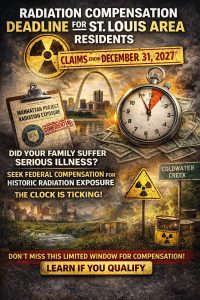
For years, radioactive waste tied to the Manhattan Project has been a source of concern for many families in the St. Louis area. Now it is also a compensation issue, and for some people, a very real one. Under the expanded Radiation Exposure Compensation Act, or RECA, some residents in parts of the St. Louis region may already qualify for federal compensation if they lived, worked, or went to school in certain ZIP codes for at least two years after January 1, 1949, and later developed a covered illness.
This matters because a lot of people still do not realize this is no longer just a proposal or a political talking point. It is active. Claims can be filed now. For eligible living claimants, compensation may be the greater of $50,000 or documented unreimbursed out of pocket medical expenses related to the covered illness. For deceased individuals, surviving spouses or children may also be eligible for compensation under the current law. The current filing deadline is December 31, 2027, so this is something families who may qualify should not put off.
There is also a new bill in Congress that could expand eligibility even further. That proposal would add more St. Louis ZIP codes, more covered illnesses, and higher compensation, but it is important to remember that part is not law yet. The current law is what matters today, and anyone who thinks they may qualify should focus first on whether they meet the existing requirements and start gathering the records they may need.
This is not a real estate story in the traditional sense, but it is absolutely a community story, and community issues affect real estate. Families buying, selling, inheriting, or simply trying to stay in their homes are often also dealing with health issues, legal questions, and the financial strain that comes with both. When something like this has the potential to impact thousands of local residents, it is worth understanding.
To make it easier, I put together a simple consumer guide that breaks down who may qualify now, what the current ZIP codes are, what illnesses are covered, what compensation may be available, and what expansion has been proposed. You can view that guide below.