This fall, my sister and her adult sons were helping our dad clean out his garage and workshop. As things headed toward the discard pile, my sister kept rescuing certain items. We’d grown up seeing them in Dad’s workshop, so the fact that they had been there for as long as we could remember made them seem important.
Dad eventually came out, looked around and wanted to know why they’d left all that junk behind. Apparently, we had confused longevity with sentiment. Some of those things hadn’t survived decades because Dad treasured them. They had survived because Dad hadn’t cleaned out the garage.
It was funny, but it also made me think about how much we assume about the things that fill our parents’ homes. The chair that has always been in the corner must mean something. The tools Dad has had forever must be special. The dishes that came out every Thanksgiving must surely be something one of the kids will want. Maybe they are, or maybe nobody ever got around to getting rid of them.
My mother, who has since passed away, handled some of her possessions very differently. When she realized she was developing dementia, there were certain belongings she knew she wanted specific people to have. She didn’t wait. She gave them away herself while she could still make those decisions, and it gave her genuine pleasure to know they were in the hands she had chosen. She was also able to give something else along with those possessions: their stories.
That’s easy to overlook when we think about inheritance. An object can pass from one generation to another, but the story that made it important doesn’t always go with it. If nobody knows why an old watch was saved, who is in a photograph or where a piece of furniture came from, eventually it can become impossible to distinguish a family treasure from something that simply occupied the house for a very long time. Sometimes the family gets it exactly backward. We may throw away something that mattered because we don’t know its story, or preserve something that never mattered because we’ve invented one.
For longtime homeowners, all of this can eventually become part of a real estate decision. A house doesn’t become empty simply because it’s time to move, downsize or transfer it to the next generation. Decades of living still have to go somewhere. Moving from a larger home to a smaller one isn’t just a decision about square footage. It can mean confronting every closet, basement shelf, kitchen cabinet, box of photographs and corner of the garage. From the outside, that can look like a project waiting to be tackled. From inside the house, it may feel very different.
I see that with my dad too. My parents built a life together, and much of that life is still represented by the things in their home. I suspect that what can look like procrastination from my side isn’t always that simple. Sorting through a house after losing the person who shared it with you isn’t necessarily the same thing as cleaning out a closet. Some things really are junk. Dad has already established that. Others may hold memories, and sometimes figuring out which is which is part of the work.
I don’t think the answer is telling older homeowners to get rid of their stuff so their children won’t have to deal with it later. If someone enjoys a home and the things in it, that’s reason enough to keep them, and adult children don’t get to decide what their parents should consider valuable. But there may be value in talking about it while everyone can still participate.
Rather than assuming we know what matters, we can ask. Is there a reason something has been kept? Is it intended for a particular person? Does anyone else in the family actually want it? The answers may be surprising. An ordinary-looking object may have a story no one else has heard, while something the family has been mentally preserving for the last 20 years may be something Dad would happily toss tomorrow.
There can also be something wonderful about not waiting. My mother got to choose where certain things went, explain their significance and see them received. The people she gave them to didn’t have to wonder later whether she would have wanted them to have them. They knew.
Not every possession needs that treatment, and that’s probably the point. A house full of belongings doesn’t have to become a house full of heirlooms. The goal doesn’t have to be deciding the fate of everything years in advance. It may simply be identifying the exceptions: the things with stories that shouldn’t be lost, the things intended for particular people and the things someone else genuinely wants.
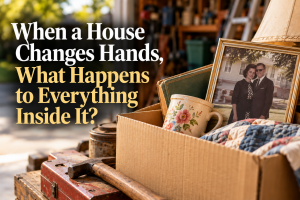
Eventually, every house changes hands, and someone will decide what happens to everything inside it. Maybe it’s worth having some of those conversations while the people who know the stories are still there to tell them.

Karen Moeller
STLKaren.com
Karen.McNeill@STLRE.com
314.678.7866
About the Author:
Karen Moeller is a St. Louis area REALTOR® with MORE, REALTORS® and a regular contributor to St. Louis Real Estate News, helping clients make informed, data-driven decisions.