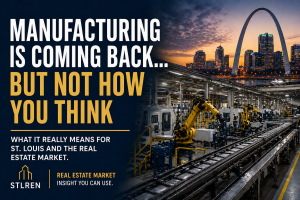
There has been a growing wave of reporting and investment announcements pointing to a return of manufacturing activity to the U.S., with over $1.5 trillion in projects announced since 2025.
On the surface, that sounds like the kind of shift that should dramatically reshape local real estate markets. More jobs, more demand, rising home prices. It is an easy story to tell, but reality is more complicated.
Manufacturing is coming back, but it does not look like it did a generation ago, and it does not impact housing the way many people expect.
Modern manufacturing facilities are smaller, more automated, and require fewer workers. A new facility today may represent a significant investment, but it does not necessarily bring thousands of new jobs into a market. In many cases, it brings a few hundred positions, often requiring specialized skills.
That difference matters when you start looking at housing. In the past, a large plant opening could create immediate, visible pressure on local housing supply. Today, the effect tends to be more gradual and more localized. Instead of a broad surge across an entire metro area, demand shows up in specific pockets, often near major transportation corridors, existing industrial zones, or areas with access to a trained workforce.
St. Louis is not typically mentioned as one of the headline markets for reshoring, but it is quietly positioned to benefit due to its central location, established transportation infrastructure, and existing manufacturing base.. The region already has a strong manufacturing base, including aerospace, food production, and a growing presence in bioscience and ag-tech. Rather than large, highly visible announcements, what tends to happen here is incremental. Existing facilities expand. Supply chains shift. Supporting industries grow alongside them. Those changes do not always make headlines, but they still influence the market.
One of the more overlooked effects is how manufacturing supports what might be considered “middle demand.” These are working households – skilled trades, technicians, and mid-level professionals – looking for practical housing within a reasonable commute. These are not luxury buyers driving the top end of the market, and they are not entry-level buyers relying on subsidies or assistance. They are steady, employed households looking for practical housing within a reasonable distance of where they work. That kind of demand does not create spikes, but it does create stability.
It also has a ripple effect beyond the facilities themselves. Manufacturing activity supports logistics, warehousing, and smaller supplier networks, particularly along major corridors like I-70 and in areas such as Earth City and the Metro East. As those sectors grow, they bring additional employment into the area, often in locations that are not immediately obvious to buyers focused on traditional residential patterns.
The result is a type of market movement that is easy to miss if you are only watching headline numbers. Home prices may not jump dramatically because of a single project, but certain submarkets may remain more competitive than expected. Areas near key corridors or employment centers may see more consistent activity, even when the broader market slows. This is the kind of growth that does not always get attention, but it plays a role in how a market performs over time.
For buyers and sellers, the takeaway is not that manufacturing is about to transform the St. Louis housing market overnight. It is that underlying economic shifts, even subtle ones, can influence where demand shows up and how stable that demand remains. In a market where many people are focused on interest rates and inventory levels, it is easy to overlook these quieter forces. They may not drive the headlines, but they often explain why some parts of the market stay steady while others don’t.

Karen Moeller
STLKaren.com
Karen.McNeill@STLRE.com
314.678.7866
About the Author:
Karen Moeller is a St. Louis area REALTOR® with MORE, REALTORS® and a regular contributor to St. Louis Real Estate News, helping clients make informed, data-driven decisions.