It rained hard last night.
The kind of rain that makes you pause for a second and wonder where all that water actually goes. Most of the time, it’s just background noise. But if you’re in the middle of buying a home in St. Louis, that question starts to matter a lot more.
Because somewhere between the showing and the offer, there’s a moment buyers don’t always expect.
It usually goes like this.
You find a house you love. The layout works. The price feels right. Maybe it even backs up to water or sits just close enough to feel like you’re getting something special.
And then someone says, “Have you checked the flood map?”
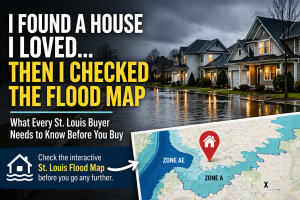
Before you go any further, this is the map I tell buyers to look at first:
👉 Check the interactive St. Louis flood map before you go any further
From there, things tend to shift quickly.
Most buyers assume flood zones are simple. You’re either in one or you’re not. In reality, it’s more nuanced than that. Zones like A and AE carry different implications for insurance and lending, but even homes outside those lines can still be affected by proximity to water, elevation, and drainage patterns that don’t show up in a quick online search.
That’s where the surprises start.
Flood insurance is one of the first things that comes up. Some buyers are required to carry it. Others aren’t, but choose to anyway. The cost can vary more than people expect, depending on elevation, prior claims, and how the property is rated. It’s not unusual for two homes on the same street to have very different insurance scenarios.
Then there are the things buyers don’t always connect to flooding right away.
Water doesn’t have to come into the house to create problems. High water levels can impact drainage systems, increase the likelihood of sump pump activity, contribute to long-term moisture issues, or make certain types of maintenance more important than they would be elsewhere. None of these are automatic dealbreakers, but they are part of the full picture.
And then there’s resale.
Even when a home hasn’t had issues, the perception of risk can influence how future buyers respond. Some will move forward without hesitation. Others will pause the same way you just did.
At this point, a lot of buyers start to wonder why anyone would choose to live near a flood-prone area at all.
But they do. On purpose.
There are real reasons for it. Proximity to water, privacy, views, and in some cases pricing advantages compared to similar homes just outside the area. For some buyers, those trade-offs make sense. For others, they don’t. The key is understanding what you’re choosing, not discovering it after the fact.
If you’re actively looking, there are a few things worth doing before you get too far down the path with any one house.
Check the flood map early, not after you’re emotionally invested. If you haven’t already, you can pull it up here and see exactly how a property is positioned before you get too far down the path.
Look beyond the label and pay attention to elevation and surrounding terrain. Ask questions about past water events, even if the seller disclosures don’t raise concerns. And if flood insurance might be part of the equation, get a rough idea of cost before you’re writing an offer.
None of this is meant to scare buyers away from homes near water. Some of those properties are incredible, and in the right situation, they can be a great fit.
But flood zones are one of those details that can quietly change the math, the risk, and the long-term plan for a home.
It’s a lot easier to understand that before you fall in love with the house than after.
If you’re trying to sort through how this applies to a specific home or area, that’s where working with someone who actually understands the local nuances can make all the difference.

Karen Moeller
STLKaren.com
Karen.McNeill@STLRE.com
314.678.7866
About the Author:
Karen Moeller is a St. Louis area REALTOR® with MORE, REALTORS® and a regular contributor to St. Louis Real Estate News, helping clients make informed, data-driven decisions.