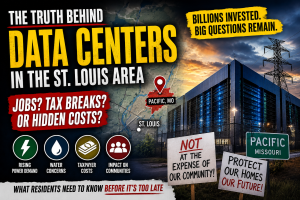
Over the past couple of years, data centers have quietly gone from being something most people never thought much about to suddenly becoming one of the hottest topics in economic development, utilities, AI, commercial real estate and even residential real estate. Around the country, cities and counties are aggressively competing for these projects, often offering massive tax incentives while promoting them as the future of economic growth and technology infrastructure, while at the same time, more communities are starting to push back and ask whether the benefits are really as large as advertised and whether taxpayers and residents are ultimately the ones absorbing the long-term costs. That debate is no longer something happening somewhere else either because it is now happening right here in the St. Louis area, and perhaps nowhere more controversially right now than Pacific, Missouri.
The Pacific Data Center Controversy
The proposed Pacific data center project has become one of the most talked-about development controversies in the region, drawing sharp debate over tax incentives, infrastructure demands, transparency, power usage, long-term community impact and exactly what residents are really getting in return. Supporters view it as a transformational economic development opportunity that could bring investment, infrastructure upgrades and future growth, while critics question the long-term benefit to taxpayers and whether the burden on utilities and infrastructure could outweigh the economic gains. The controversy in Pacific mirrors what is now happening in communities all over the country as local governments try to balance the lure of high-tech investment with growing concerns over electrical demand, water usage, tax incentives and quality-of-life impacts.
And Pacific is not the only proposed project in the area. There are now multiple proposed data center developments either in or around the St. Louis metro area, including the proposed redevelopment of the former Emerson Electric campus in Ferguson that reportedly could involve billions of dollars in investment and substantial public incentives. There has also been ongoing discussion regarding projects in Jefferson County, Troy and other rural Missouri areas as developers increasingly look for large tracts of land with access to major electrical infrastructure and fiber connectivity.
Rural Missouri Becoming A Data Center Battleground
St. Louis Magazine recently did an interesting piece discussing how rural Missouri is quickly becoming a battleground over data center development as communities weigh the economic potential against concerns involving infrastructure strain, utility demand, water usage and long-term community impact. Click here to read the St. Louis Magazine article.
After digging through actual studies, policy reports and data from credible organizations instead of social media opinions and political talking points, what became pretty obvious is that the reality is a lot more complicated than either side tends to admit. On one side, there is absolutely no question that data centers are becoming critical infrastructure for the modern economy. AI, cloud computing, online banking, logistics, streaming, healthcare systems and government operations all depend heavily on massive amounts of computing power and data storage. Whether people like it or not, the digital economy increasingly runs on data centers, and areas that attract them could potentially benefit from industrial redevelopment, construction activity, infrastructure investment and long-term tax revenue. But on the other side, there is also growing evidence that many communities may not fully understand the long-term tradeoffs involved.
The Jobs And Economic Impact Question
One of the more interesting studies I found came from the Brookings Institution, which is generally considered one of the more respected policy think tanks in the country. Their research specifically looked at the economic and employment impacts of data centers and found that while construction activity can certainly be substantial during development, the number of permanent long-term jobs created after completion is often far lower than many communities assume when these projects are announced. In some cases, enormous facilities costing hundreds of millions or even billions of dollars may only create a relatively modest number of permanent employees once operational. That does not necessarily make them bad projects, but it certainly raises legitimate questions about whether some communities are offering tax incentives that are proportional to the long-term economic return they are actually receiving.
Click here to read the Brookings Institution study on data center employment and economic impact.
Will Data Centers Push Utility Costs Higher?
Another issue that keeps coming up repeatedly in the research is electricity demand. AI and large-scale cloud computing require enormous amounts of power and according to Reuters, Bloomberg and several policy organizations, data centers are rapidly becoming one of the largest drivers of increased electrical demand in parts of the United States. Some experts believe the infrastructure upgrades necessary to support this growth could eventually contribute to higher utility costs for consumers and businesses. Reuters recently explored whether some of the costs associated with electrical grid upgrades for data center growth are effectively being shifted onto consumers through utility rate increases and infrastructure spending, while Bloomberg reported on growing concerns that AI-related data center demand is contributing to rising electricity prices in certain markets. That matters to homeowners, renters, landlords and commercial property owners because utility costs directly impact affordability, operating expenses and property values.
Click here to read the Reuters report on data centers and rising utility costs.
Click here to read the Bloomberg report on AI and electricity demand.
Water Usage And Environmental Concerns
Water usage and environmental impact are also becoming major discussion points surrounding large-scale data center development. Some modern facilities require substantial amounts of water for cooling systems, and depending upon the location and utility infrastructure, those demands can become significant. The World Resources Institute recently published one of the better balanced reports I found because it was not anti-development or anti-technology but instead simply laid out the facts involving power consumption, water use, land use, air pollution concerns and local infrastructure impacts. Their report discusses both the positives and negatives and is probably worth reading for anyone who wants an objective overview of the issue rather than an opinion piece.
Click here to read the World Resources Institute report on data center impacts.
A More Balanced Look At The Pros And Cons
Interestingly, even organizations that are generally supportive of economic development and technology growth are now acknowledging that communities need to negotiate these projects carefully and fully understand the economics before approving them. Another Brookings report argues that data centers absolutely can provide long-term economic benefits if agreements are structured properly and if local governments ensure communities receive meaningful benefits in exchange for incentives and infrastructure support. In other words, the real debate may not be whether data centers are automatically good or bad, but whether communities are negotiating smart deals and fully understanding the long-term impacts before approving them.
The Real Estate Impact
This is also increasingly becoming a real estate issue and not just a technology or political discussion. Industrial land values in areas attractive for data center development could potentially increase substantially, especially sites with existing heavy utility infrastructure, fiber connectivity and transportation access. Older industrial campuses that might otherwise struggle for redevelopment suddenly become attractive candidates because they already possess some of the infrastructure these projects require. Former manufacturing facilities, warehouse districts and industrial corridors throughout the St. Louis area could potentially benefit from renewed interest and investment.
At the same time, nearby residential areas could potentially experience concerns involving noise, aesthetics, transmission lines, electrical substations and environmental impacts depending upon the scale and location of the projects. There are already examples nationally where residents have pushed back against proposed developments because they believe the long-term impacts were not fully explained upfront, and Pacific appears to be quickly becoming one of those examples locally.
The Bottom Line
Personally, after reviewing a lot of the research and data, I think there are legitimate arguments on both sides. Some opponents act as though every data center is automatically bad, which is probably unrealistic considering modern society increasingly depends upon them. On the other hand, some politicians, developers and economic development agencies seem to market these projects as pure economic jackpots without fully discussing infrastructure costs, tax incentives, electrical demand and relatively modest permanent employment numbers compared to traditional manufacturing facilities.
Like most things in real estate and development, the reality is probably somewhere in the middle and the key is making decisions based upon actual facts and long-term economics instead of hype, fear or politics. Fortunately, there is now enough credible research available for communities, property owners and taxpayers to start asking much better questions before jumping headfirst into these deals.