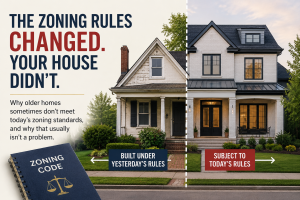
Why older homes sometimes don’t meet today’s zoning standards, and why that usually isn’t a problem.
Driving through Glendale recently, I noticed signs inviting residents to an open house about the city’s zoning code update. Like most drivers, I could have continued on without giving it another thought. Instead, I found myself wondering what would prompt a city to rewrite its zoning code.
As I read through the planning documents, one statistic immediately caught my attention. Nearly 45% of Glendale’s residential lots no longer conform to today’s zoning regulations.
My first reaction was probably the same one many homeowners would have.
How can nearly half the homes in a city not comply with the zoning code?
The answer is surprisingly simple.
The houses didn’t change.
The rulebook did.
That idea feels backward because most of us assume that if a home exists today, it must automatically comply with today’s rules. In many older communities, that’s simply not true.
Take a walk through neighborhoods in Kirkwood, Webster Groves, Maplewood, Glendale, University City, or other established St. Louis communities. Many of those homes were built decades before today’s setback requirements, lot coverage limits, stormwater regulations, parking standards, and other zoning rules existed. They complied with every requirement in effect when they were built. Over the years, however, cities updated their ordinances as neighborhoods evolved, development patterns changed, and community priorities shifted.
The homes remained exactly where they were.
The regulations continued to evolve around them.
Earlier this year, I listed an older home in Kirkwood where this became more than just an interesting planning concept. The sellers hoped a builder would purchase the property, tear down the existing home, and construct a substantially larger residence. Several nearby properties had followed a similar path, so the expectation seemed reasonable.
Once builders evaluated the property under today’s zoning regulations, however, the picture changed. Current setback requirements, stormwater regulations, and other development standards limited what could realistically be built on the lot. The economics no longer supported the type of replacement home everyone had envisioned.
Nothing was wrong with the property.
Nothing had changed about the lot.
What had changed was the rulebook that governed what could be built there today.
That experience illustrates an important point. Zoning doesn’t just influence future development. It can influence the market value of land, renovation possibilities, and even which buyers are interested in a property.
City planners have a formal name for homes and lots that no longer meet today’s zoning standards but were lawfully established under earlier regulations. They are called legal nonconforming properties. Most homeowners simply know them as being “grandfathered.”
The distinction matters because many people assume “grandfathered” means a property is exempt from future zoning rules forever. That’s not quite how it works.
Missouri recognizes that lawfully established nonconforming properties have important legal protections. At the same time, Missouri law gives cities and counties broad authority to adopt many of the day-to-day rules governing those properties. Whether a nonconforming structure may be expanded, significantly altered, rebuilt after major damage, or otherwise modified is often determined by the local zoning ordinance rather than a single statewide rule.
In other words, there is no universal Missouri answer to questions such as, “Can I add onto my house?” or “Can I rebuild exactly what I have today?” The answer often depends on where the property is located and what the local zoning code allows.
The good news is that most homeowners will never encounter these issues. If you simply live in your home and maintain it, legal nonconforming status may never affect you.
The conversation becomes much more important when significant change is involved.
Perhaps you’re buying an older home because you dream of adding a large primary suite. Maybe you’re planning to replace a detached garage, build a major addition, or purchase a property that seems like an ideal tear-down opportunity for new construction. Those are the moments when assumptions can become expensive.
Before investing in architectural plans, hiring contractors, or paying a premium based on what you hope to build, make sure you understand what today’s zoning ordinance actually allows.
One of the most interesting things I learned from Glendale’s zoning update had nothing to do with Glendale.
It was a reminder that every older home tells two stories.
One is the story of when it was built.
The other is the story of every zoning ordinance that has been adopted since.
Understanding where those two stories intersect may not matter every day you own your home.
But when it does, it can make all the difference.

Karen Moeller
STLKaren.com
Karen.McNeill@STLRE.com
314.678.7866
About the Author:
Karen Moeller is a St. Louis area REALTOR® with MORE, REALTORS® and a regular contributor to St. Louis Real Estate News, helping clients make informed, data-driven decisions.