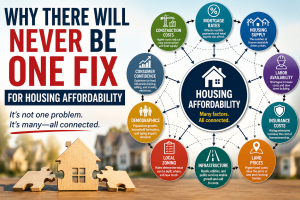
The House’s new ROAD to Housing Act highlights an important truth: America’s housing challenges weren’t created by a single problem, and they won’t be solved by a single law.
Every few months, a new headline promises relief for America’s housing market.
Sometimes the proposed solution is lower mortgage rates. Sometimes it’s tax credits for first-time buyers. Other times it’s down payment assistance, zoning reform, or a program designed to make homeownership more accessible. Each proposal arrives with roughly the same promise: this could be the thing that finally makes housing affordable again.
The latest example is the 21st Century ROAD to Housing Act, a bipartisan package recently approved by the House of Representatives. The legislation touches dozens of areas of housing policy, from encouraging new construction to modernizing financing programs and removing barriers that supporters believe have made it unnecessarily difficult to build homes.
Whether the bill ultimately becomes law remains to be seen. The Senate would still need to approve it before it reaches the President’s desk. Yet almost as interesting as the legislation itself is the public reaction to it. Within hours, headlines and social media posts were already asking whether this would finally bring home prices back down.
That question reveals a misunderstanding that has followed the housing market for years.
We tend to talk about affordability as though it’s one problem waiting for one solution.
It isn’t.
If anything, housing behaves less like a math equation and more like an ecosystem. Every part affects every other part, sometimes in ways that aren’t immediately obvious. Change one variable and several others respond, often months or years later.
Take mortgage rates, for example. When rates climbed over the past few years, they understandably became the villain in almost every housing conversation. Higher borrowing costs certainly reduced purchasing power, but they also persuaded millions of homeowners to stay exactly where they were because giving up a three percent mortgage felt financially irrational. Fewer homeowners listed their properties. Inventory tightened. Buyers found themselves competing over a smaller pool of homes, helping prices remain surprisingly resilient even as affordability declined.
Mortgage rates didn’t create the entire problem.
They simply changed the behavior of nearly everyone participating in the market.
The same can be said for construction costs. As materials became more expensive and labor became harder to find, building new homes became a riskier proposition. Insurance premiums climbed. Development costs increased. In many communities, conversations about density, infrastructure, traffic, schools, and neighborhood character made approving new housing projects increasingly complicated.
None of those factors, standing alone, explains today’s housing market.
Together, they explain quite a lot.
That’s why I find the ROAD to Housing Act interesting, not because I expect it to dramatically change the market over the next year, but because it acknowledges something the industry has been wrestling with for a long time. You can’t solve a housing shortage simply by making it easier for people to buy homes. At some point, the country also has to build more of them.
That sounds almost obvious until you consider what “building more homes” actually means.
It’s easy to picture a vacant field becoming a subdivision. It’s much harder to appreciate everything that has to happen before the first family ever receives a set of keys. Land must be acquired. Financing secured. Plans drawn. Utilities extended. Roads improved. Permits issued. Contractors hired. Materials sourced. Inspections completed.
Every step introduces time, cost, and complexity.
Even communities that genuinely want additional housing often find themselves navigating competing priorities. Residents want homes that young families can afford, but they also want manageable traffic, quality schools, sufficient infrastructure, parks, and neighborhoods that retain the qualities that attracted them in the first place.
Those aren’t contradictory values.
They’re simply difficult to balance.
That’s one reason national housing policy can only accomplish so much.
Congress can create incentives. It can modernize lending programs. It can encourage development and remove certain federal barriers. What it cannot do is decide whether a particular municipality embraces redevelopment, approves higher-density housing, invests in infrastructure, or changes local zoning policies. Those decisions happen much closer to home, and they often determine whether additional housing actually gets built.
For those of us here in the St. Louis region, that’s an important distinction.
National policy influences the environment in which real estate operates, but our market is shaped just as much by local decisions. A redevelopment project in Kirkwood, a new subdivision in St. Charles County, infrastructure improvements in one municipality, or zoning changes in another can have a more immediate impact on local inventory than anything debated in Washington.
That’s why I always encourage buyers and sellers to read national housing headlines with curiosity rather than certainty.
The latest bill isn’t likely to make homes suddenly cheaper next spring. Nor should sellers assume it’s about to flood the market with new competition. Markets rarely move in dramatic, overnight shifts. They evolve through hundreds of decisions made by builders, lenders, local governments, homeowners, developers, and buyers, each responding to the conditions in front of them.
Perhaps that’s the biggest lesson hidden inside this legislation.
Housing affordability was never one problem.
It has always been the intersection of supply, financing, construction costs, labor availability, insurance, infrastructure, land use, demographics, and local policy. Pulling on any one of those threads changes the picture, but it doesn’t rewrite it.
That’s also why anyone promising a single solution should make us pause.
Real estate has a habit of humbling simple answers.
Progress usually arrives the same way neighborhoods are built: one lot at a time, one permit at a time, one decision at a time. It’s slower than we’d like, less dramatic than politicians often suggest, and rarely captured in a single headline.
But that’s almost always how meaningful change happens.

Karen Moeller
STLKaren.com
Karen.McNeill@STLRE.com
314.678.7866
About the Author:
Karen Moeller is a St. Louis area REALTOR® with MORE, REALTORS® and a regular contributor to St. Louis Real Estate News, helping clients make informed, data-driven decisions.