Most homeowners assume that once they buy a property, they have control over what happens on it. In reality, that control exists within a system of rules that often don’t come into focus until something forces the issue.
That moment can be bigger, like the recent effort in Kirkwood to stop the demolition of a historic home. Or it can be something far more routine. A property condition that has existed for years, something as simple as how materials are stored or where they are placed, suddenly draws attention. A notice arrives outlining specific requirements and a timeline to correct them. Nothing about the rule has changed. Only the enforcement has.
That contrast highlights something many homeowners don’t fully realize: property rights are not just about ownership. They operate within a system that balances individual use with community standards, and that system relies on process, not impulse.
At the center of that system is a concept most people rarely think about until they encounter it firsthand: due process.
In real estate, due process shows up less as a legal concept and more as a sequence. A rule exists. Something triggers enforcement. A notice is issued. Time is given to respond. Only then does it escalate.
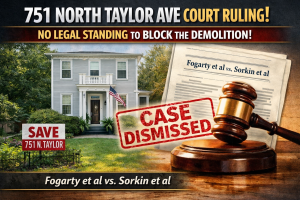
The recent Kirkwood case brought this into focus in a visible way. A group of residents organized, filed legal action, and pushed to stop the demolition of a historic home, arguing for its preservation and community value. The city’s Landmarks Commission had the authority to review and delay the demolition, but not to prevent it outright. Ultimately, the courts allowed the property owner to move forward.
The situation raises a natural question: how much weight should community opposition carry when it conflicts with an owner’s legal rights?
It does carry weight. But it does not override the legal framework that governs property rights.
That same framework shows up in far more common situations. Local ordinances regulate how property can be used, maintained, and modified. Those rules cover everything from structural changes to seemingly small details like where materials are stored or how close something can be placed to a property line. In most cases, enforcement is not constant. It is triggered by a complaint, an inspection, or a specific review.
Once something is flagged, the process begins. A notice is issued. Requirements are outlined. A timeline is given. Only if those steps are ignored does the situation escalate further.
Property line issues follow a similar pattern. When something crosses a boundary, whether it is a structure, drainage, or invasive plant growth, it does not become a matter of personal negotiation. It falls into a defined legal framework designed to determine responsibility and resolution.
The underlying tension in all of these situations is the gap between expectation and reality. Many homeowners believe ownership comes with complete control. Others assume community opinion should carry more weight than it legally does. In practice, neither is entirely correct.
Ownership provides significant rights, but those rights exist within a system that also considers safety, consistency, and the impact on surrounding properties.
That system is not always fast, and it is not always satisfying to everyone involved. It can feel frustrating when enforcement appears inconsistent or when outcomes do not align with public sentiment. But the alternative, decisions made without structure or standard, creates far more uncertainty for property owners.
For buyers and sellers, this is more than a theoretical discussion. It affects how properties are used, what changes are possible, and how disputes are resolved. It also shapes expectations. Understanding that these processes exist can prevent surprises and, in some cases, avoid conflict altogether.
The recent situation in Kirkwood did not create a new issue. It simply made an existing one more visible.
Property rights are not absolute, but they are not arbitrary either. They are defined in advance, enforced through a process, and designed to hold up even when opinions don’t.

Karen Moeller
STLKaren.com
Karen.McNeill@STLRE.com
314.678.7866
About the Author:
Karen Moeller is a St. Louis area REALTOR® with MORE, REALTORS® and a regular contributor to St. Louis Real Estate News, helping clients make informed, data-driven decisions.