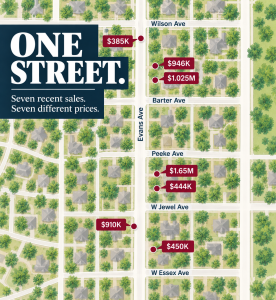
A homeowner tells me their house is worth $500,000 because an online valuation tool says so.
The county assessor values it at $380,000.
The appraiser comes in at $465,000.
A buyer offers $450,000.
Who’s right?
Potentially all of them.
One of the most common misconceptions in real estate is that every house has a single, objective value waiting to be discovered. In reality, residential real estate is one of the few assets where several reasonable values can exist at the same time because different people are trying to answer different questions.
That distinction helps explain why homeowners, buyers, lenders, appraisers, assessors, and online valuation tools can all arrive at different numbers for the same property.
Why Sellers and Buyers Rarely Agree
Most homeowners do not look at their property the same way a buyer does.
They remember the kitchen renovation completed five years ago, the roof they replaced, the landscaping they improved, and the weekends spent maintaining the home. They know which features visitors compliment and which projects cost far more than expected.
Buyers see something different.
They are comparing the home to every other property available in their price range. They are evaluating location, condition, future maintenance, and whether another house might offer more value for the same money.
Neither side is necessarily wrong. They are simply viewing the property from different perspectives. Sellers often see value through the lens of investment and experience, while buyers view value through the lens of alternatives and affordability.
The Value a Lender Is Willing to Support
When a lender orders an appraisal, the goal is not to determine what the seller thinks the home is worth or even what a particular buyer is willing to pay.
The appraiser is developing a professional opinion of market value based on recent comparable sales, market conditions, and the property’s characteristics. That opinion helps the lender determine whether the property supports the amount being borrowed.
This is why a home can attract multiple offers at one price and still appraise for something different. The buyer and seller are negotiating a purchase. The appraiser is estimating market value. While those numbers often align, they are not required to.
That does not mean the appraiser is wrong, nor does it mean the buyer and seller are wrong. They may simply be answering different questions.
The Value the Government Uses
Property assessments create another layer of confusion.
Many homeowners assume their assessed value reflects what their home would sell for on the open market. In reality, assessments are developed for taxation purposes, not for buying and selling decisions.
Assessment methodologies vary by jurisdiction, update cycles differ, and values often lag behind changing market conditions. As a result, an assessed value may be significantly higher or lower than what a buyer would actually pay today.
That does not necessarily mean the assessment is inaccurate. It means the assessment was created for a different purpose.
The Value the Internet Thinks It Is
Online valuation tools have become incredibly popular because they provide instant answers.
The challenge is that real estate rarely fits neatly into an algorithm.
An online estimate may know the square footage, lot size, bedroom count, and recent sales nearby. What it often cannot fully account for are factors such as condition, quality of updates, floor plan functionality, deferred maintenance, views, or improvements that never made their way into public records.
Sometimes these estimates are remarkably close.
Sometimes they miss by a wide margin.
The important thing to remember is that they are estimates, not appraisals, inspections, or purchase contracts.
The Only Value That Ultimately Matters
For all the attention paid to assessments, appraisals, and online estimates, there is one value that ultimately determines whether a home sells: market value.
Even that phrase is frequently misunderstood.
People often say a house is worth whatever someone is willing to pay for it. That is only part of the equation. A house is worth what a willing buyer will pay and a willing seller will accept under normal market conditions.
If either side disagrees, a sale does not occur.
That is why market value constantly changes. Interest rates change. Inventory changes. Economic conditions change. Buyer preferences change. What buyers were willing to pay three years ago may not be what they are willing to pay today.
The house may be exactly the same.
The market is not.
So Who’s Right?
The answer depends on the question being asked.
A seller trying to decide whether to move, a lender evaluating collateral, a county determining taxes, and an online valuation model generating an estimate are all approaching value from different directions and for different purposes.
The challenge is not determining which number is universally correct. The challenge is understanding what each number represents.
Real estate is one of the few assets where multiple reasonable values can exist at the same time.
The confusion begins when people assume they are all trying to measure the same thing.

Karen Moeller
STLKaren.com
Karen.McNeill@STLRE.com
314.678.7866
About the Author:
Karen Moeller is a St. Louis area REALTOR® with MORE, REALTORS® and a regular contributor to St. Louis Real Estate News, helping clients make informed, data-driven decisions.