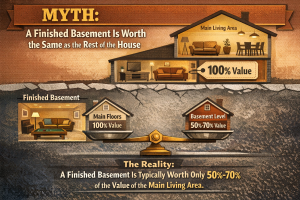
Reality: Lower-level space adds value, but it is priced differently
That beautifully finished basement may help sell the home, but it is not valued the same way.
“I mean, it’s basically another level.”
If you’ve ever walked through a well-finished basement in St. Louis, you’ve probably heard some version of that comment. And to be fair, some of them feel like it. Full bars, theater setups, extra bedrooms, even second kitchens can make the space feel like a natural extension of the home, but when it comes to value, the market draws a clear line between above-grade and below-grade space.
How value is actually determined
In real estate, not all square footage is treated equally. Above-grade living space drives most pricing comparisons and appraisals. Below-grade space, including finished basements, is considered separately regardless of finish level.
That distinction comes down to function. Basements typically have less natural light, different egress considerations, and a greater potential for moisture. Even when beautifully finished, they are not used the same way as the main levels of a home. Because of that, the market consistently assigns them a different value.
What the numbers tend to look like
A finished basement absolutely adds value. It just does not add it dollar for dollar. Appraisers typically assign a lower per-square-foot value to below-grade space compared to above-grade living area. There is no fixed percentage, but the difference is consistent across the market.
Certain features can increase how that space is perceived and valued:
A bathroom in the basement generally adds more value than open finished space alone
A bedroom with proper egress increases usability and appeal
Open recreation space tends to carry the least weight on its own
These adjustments are based on how buyers respond to the space, not a direct conversion of square footage.
What about walk-outs, ceiling height, and hillside homes?
These features can absolutely influence value, but they do not always change how the space is classified. Walk-out basements tend to carry more value than standard basements because they bring in natural light and improve usability. Higher ceiling heights can have a similar effect, making the space feel more like a main level.
However, classification is based on grade, not feel. If any portion of that level is below ground, it is typically treated as below-grade space for valuation purposes.
This becomes especially relevant in hillside homes, where a lower level may be fully exposed from the back but below grade from the front. Even when the space lives like a main floor, it is often still categorized as below grade.
There are exceptions depending on layout and comparable sales, but the general rule holds. The way a space is experienced and the way it is valued are not always the same.
Where expectations get off track
Most homeowners remember what they spent to finish the basement. Buyers focus on how they will use it. Those perspectives do not always align. It is common to see sellers expect full or near-full value for finished lower levels, especially when the space feels like a continuation of the home. The market, however, applies a different standard.
What this means for homeowners
This does not mean finishing a basement is a bad investment. It means the return shows up in more than one way. A well-designed lower level can make a home more competitive, appeal to a broader range of buyers, and improve day-to-day living.
Where homeowners run into trouble is over-improving relative to how the space will be valued. High-end finishes in a basement do not typically return the same percentage as similar finishes above grade. That does not mean avoid quality. It means prioritize function, flexibility, and consistency with the rest of the home.
How to use this to your advantage
For sellers, this becomes a pricing strategy.
When a home is priced based on its above-grade value, the finished basement becomes a differentiator rather than a justification for a higher price. That often leads to stronger interest and better offers.
For buyers, it can create opportunity.
Two homes with similar main-level layouts may feel very different depending on the lower level. When that space is not fully reflected in the price, it can represent added usability without a proportional increase in cost.
A quick note on bedrooms below grade
Bedrooms in basements must meet egress requirements to be considered legal. Even when they do, they are still treated as below-grade space in valuation.
They add function and appeal, but they are not counted the same as bedrooms on the main levels of the home.
The takeaway
A finished basement adds value. It adds flexibility. It can absolutely help a home stand out. It just does not carry the same weight as the space above it. Understanding that difference helps sellers price more effectively and helps buyers recognize opportunity where others may overlook it, because in real estate, how space is used matters. But where that space is located matters just as much.

Karen Moeller
STLKaren.com
Karen.McNeill@STLRE.com
314.678.7866
About the Author:
Karen Moeller is a St. Louis area REALTOR® with MORE, REALTORS® and a regular contributor to St. Louis Real Estate News, helping clients make informed, data-driven decisions.