There is a narrative that comes up again and again. People are leaving St. Louis. It sounds convincing. It shows up in headlines and conversations. But when you look at the data, the story is far more local.
Most people who move from the St. Louis area are not heading across the country. They are staying within Missouri or moving to nearby Midwestern states. That was true when this topic was first analyzed years ago, and it remains true today.
The Moves Are Closer Than You Think
Migration data, including IRS records that track address changes on tax returns, consistently shows that most moves happen at the county level. In practical terms, that means people are relocating within the same metro area or to neighboring regions. People move from the city to the county. They move between suburbs. They move across the river into Illinois or out toward St. Charles, Jefferson, or Franklin County. Long-distance relocations happen, but they are not the primary driver of movement.
What Looks Like “Leaving” Is Often Local Movement
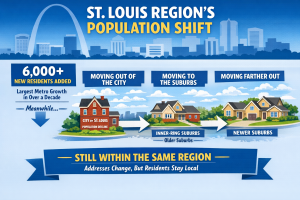
Recent Census estimates add important context. The St. Louis metro area added more than 6,000 residents over the past year, the largest increase the region has seen in over a decade. At the same time, the City of St. Louis has continued to lose population. Those two trends are not contradictory. They are connected.
What often gets labeled as people leaving St. Louis is actually movement within the same region. A household moves from the city into St. Louis County. Another moves from an inner-ring suburb to a newer home farther out. The address changes, but the buyer pool stays local.
Where People Are Actually Going
When people do move, the destinations are consistent and predictable. Movement tends to stay within the metro and nearby counties, including St. Louis County, St. Charles County, Jefferson County, and Franklin County, along with communities across the river in Illinois.
Within those areas, the pattern often looks like this:
- City to inner-ring suburbs such as Kirkwood, Webster Groves, and Maplewood
- Inner-ring suburbs to areas with newer housing or larger lots
- Downsizing or simplifying within the same general area
These are not relocation decisions driven by leaving the region. They are lifestyle decisions made within it.
Inbound and Outbound Movement Tell the Same Story
Inbound movement into the St. Louis area tends to come from other parts of Missouri, nearby Illinois counties, and regional metros within driving distance.
Outbound movement most often lands in surrounding counties or nearby Midwestern cities. Moves to distant states happen, but they represent a smaller share of overall activity.
The pattern is consistent. Movement is local. Even when it stretches beyond the metro, it is still regional.
A Market Still Driven by Local Demand
One additional factor shaping today’s numbers is international migration, which has contributed to population stability in the St. Louis metro in recent years. It is not the whole story, but it is an important piece of it. When you combine that with predominantly local movement, the picture becomes clearer. Demand in the St. Louis housing market is still being driven largely by people who already live here. They are moving up, downsizing, changing locations, or adjusting to a new phase of life. That creates a steady level of activity that does not always match the national narrative.
The idea that everyone is leaving St. Louis does not hold up under scrutiny. Most people are not leaving the region. They are moving within it and that distinction matters. A market driven by local movement behaves very differently than one losing people altogether.
Real estate decisions are local, and so is the data that drives them. If you want insight that goes beyond the headlines and actually reflects what is happening in St. Louis right now, let’s connect.

Karen Moeller
STLKaren.com
Karen.McNeill@STLRE.com
314.678.7866
About the Author:
Karen Moeller is a St. Louis area REALTOR® with MORE, REALTORS® and a regular contributor to St. Louis Real Estate News, helping clients make informed, data-driven decisions.