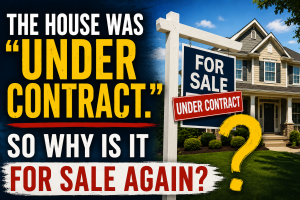
One of the more confusing moments for many homebuyers happens when they find a house they love online, only to discover it is already “under contract.”
Most buyers assume that means the home is effectively sold.
Not necessarily.
In real estate, “under contract” often means a transaction has started, not that it is guaranteed to close. Between accepted offer and closing sits a stretch of inspections, financing approvals, appraisals, title work, contingencies, and deadlines where deals can still fall apart.
And sometimes, they do.
According to the National Association of REALTORS®’ REALTORS® Confidence Index, approximately 5% of contracts were terminated nationally in recent reporting periods. Other industry data sources tracking cancellation activity in certain markets have reported even higher fallout rates during periods of economic uncertainty and rising inventory.
That surprises many buyers because listing statuses tend to sound far more final than they actually are.
In the St. Louis market, homes can move through several statuses before a sale officially closes. Terms like “contingent,” “active under contract,” “pending,” and “hold” may sound similar to consumers, but they often reflect different stages of negotiation, remaining contingencies, or transaction risk.
A home can have an accepted contract while still allowing backup offers. Another may be waiting on inspections or financing approval. Some transactions collapse because of appraisal issues, financing problems, title concerns, repair negotiations, or the buyer’s need to sell another property first.
Accepted offer and closed sale are not remotely the same thing.
That reality is one reason agents sometimes continue accepting backup offers or conducting limited marketing activity even after a contract has been accepted. The property is under contract, and buyers should absolutely be made aware of that upfront. But experienced agents also understand that contracts do not always survive the process from beginning to closing table.
That is also why buyers should not automatically dismiss homes simply because they appear unavailable online. A property that looks gone today may unexpectedly return to the market days or weeks later.
At the same time, many buyers mistakenly assume that submitting a backup offer prevents them from continuing to search for other homes. In most cases, it does not. Buyers can often continue viewing properties and pursuing other opportunities unless and until the backup position becomes primary and the buyer chooses to move forward.
Part of the confusion is structural. MLS systems were originally designed primarily for real estate professionals, not consumers scrolling listings online late at night. Over time, public-facing websites began displaying statuses that buyers often interpret in a much more black-and-white way than the transaction process itself actually operates.
In fast-moving markets, that nuance becomes even more important.
A home may go under contract within hours, remain tied up for weeks, return to the market unexpectedly, and then receive multiple new offers almost immediately. To consumers, that can make the process feel inconsistent. In reality, it reflects how many moving pieces must align for a transaction to successfully close.
For sellers, these statuses matter too. A deal falling apart can impact momentum, buyer perception, and negotiating leverage, particularly if the property cycles on and off the market multiple times. That is part of why sellers and agents often continue evaluating backup options even after accepting an offer.
None of this means listing statuses are meaningless.
They provide important signals about where a property sits within the transaction process. But they are not guarantees, and they should not always be interpreted as final outcomes.
Because in real estate, a signed contract is a major step.
It just is not the last one.

Karen Moeller
STLKaren.com
Karen.McNeill@STLRE.com
314.678.7866
About the Author:
Karen Moeller is a St. Louis area REALTOR® with MORE, REALTORS® and a regular contributor to St. Louis Real Estate News, helping clients make informed, data-driven decisions.