
UPDATE: This dispute has now moved into federal court. On October 5, 2026, CRMLS filed suit against Compass in the Southern District of New York, asking the court to declare its MLS cooperation rules lawful and to block Compass’s threatened antitrust claims involving those rules. Read my follow up on the CRMLS lawsuit against Compass here.
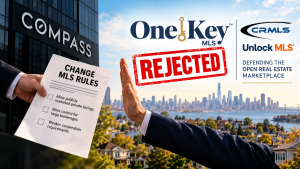
Not long ago I thought the Sitzer/Burnett commission lawsuit might be the biggest and most disruptive issue I would see hit the real estate industry. Apparently, we were just warming up. The battle over private listings, office exclusives, delayed marketing and who gets access to homes for sale has been building for a while, but this week California Regional MLS, better known as CRMLS, took the gloves off in a way I don’t think we have seen from an MLS before. Compass threatened CRMLS with a federal antitrust lawsuit if it does not change its rules, and CRMLS responded with a seven page letter essentially saying, we disagree, we are not changing the rules, and if you sue us, be prepared for us to sue you back. Compass’s September 8 demand letter gave CRMLS until October 6 to agree that agents would not be fined or punished for publicly marketing an “office exclusive” while keeping the listing out of the MLS. Compass argues that restrictions on that practice violate federal antitrust law and interfere with a seller’s ability to choose how a property is marketed. You can read Compass’s September 8 demand letter to CRMLS here.
There is an important distinction buried underneath all the legal terminology. Compass’s position is that a seller should be able to hire a broker under an exclusive listing agreement, keep the property out of the cooperative MLS, but still publicly advertise the property elsewhere. Compass argues that office exclusive listings historically were not subject to MLS restrictions on how the property could be marketed and that CRMLS is improperly reaching outside its own platform by penalizing agents for public advertising. Compass points to several MLSs that it says permit this type of public marketing and argues that allowing it increases seller choice and competition. Those are legitimate arguments that deserve to be heard, particularly in today’s antitrust environment.
But this is where I part company with Compass, because I think the larger issue is being lost in the phrase “seller choice.” The MLS is not simply a website where brokers upload listings. It is a cooperative. Brokers contribute their listing inventory and information to a common marketplace so competing brokers can find properties for their buyers and bring buyers to other brokers’ sellers. CRMLS’s position is that a broker should not be able to take advantage of that cooperative, use its competitors’ listing information and market data, and then decide that its own exclusive listings are going to be withheld from those same competitors while being advertised publicly somewhere else. CRMLS describes that as free riding, and frankly I think that description gets very close to the heart of the issue. CRMLS says its rules do not prevent a seller and broker from choosing arrangements outside the cooperative, including certain nonexclusive arrangements, but once a broker chooses to participate in the cooperative while controlling an exclusive listing, cooperation has to work both ways.
And this is where the private listing debate becomes a consumer issue rather than simply an MLS rules fight. I have never had a problem with a truly private listing when there is a legitimate reason for it. There are sellers who genuinely do not want their home broadly exposed, and there can certainly be circumstances where privacy is more important than maximum exposure. But calling a listing “private” or an “office exclusive” while advertising it to the public and then restricting who can actually access it is something entirely different. If the property is being publicly marketed, why shouldn’t a buyer be able to see it through the real estate professional that buyer has chosen to represent them?
One passage in CRMLS General Counsel Ed Zorn’s response really jumped out at me. CRMLS says it has heard from buyer agents who knew Compass properties were for sale but were unable to get cooperation in showing them. “The problem was not in the identification of hidden for-sale properties, it was in the refusal” of Compass agents to cooperate with the buyer’s agent. CRMLS alleges that inquiries went unanswered until some buyers abandoned their own agents and dealt directly with a Compass agent simply to gain access to the property. It even describes an alleged case where access to an off MLS property was conditioned on the buyer hiring the Compass agent to list the buyer’s existing home. Those are allegations made by CRMLS, not findings by a court, but if situations like that are occurring, that is exactly why this debate matters. You can read CRMLS’s complete response to Compass here.
CRMLS’s response goes much further than simply defending its rules. It puts Compass on notice to preserve documents and electronic records, identifies potential counterclaims including alleged violations of California antitrust and unfair competition laws, and says it intends to create an MLS Cooperative Legal Defense Fund to help MLS organizations defend the cooperative model. CRMLS is also asking buyers, sellers and agents who believe they have been harmed by withheld listings to come forward. Again, none of the allegations CRMLS makes against Compass have been adjudicated simply because they appear in a strongly worded demand letter, but there is no mistaking how seriously CRMLS is taking this fight.
What makes the whole thing even more interesting is that this comes shortly after Compass settled its litigation with Northwest MLS. Compass is arguing that its Northwest MLS litigation advanced seller marketing choice, while CRMLS points out that the resulting Northwest MLS rules still contain mandatory cooperation requirements that CRMLS says are, in some respects, more restrictive than its own. That disagreement will undoubtedly become part of the legal argument if Compass follows through with its October 6 deadline.
For me, however, the most important issue is much simpler than the legal maneuvering. Real estate works best when consumers are able to choose their own representation and brokers compete based upon service, knowledge, skill and value, not because one company has assembled a pool of homes that buyers cannot readily access unless they come through that company. Sellers deserve choices, absolutely. But buyers deserve choices too, including the choice of who represents them. Cooperation does not mean every seller must market a property the same way, nor does it mean every listing has to appear on every consumer website. What it should mean is that once a property is being openly offered to the marketplace, access to that property should not become a tool for steering buyers toward a particular brokerage.
This fight may be happening between Compass and a California MLS, but I think every broker, MLS, buyer and seller in the country should be paying attention. The outcome could help determine whether the MLS of the future remains a cooperative marketplace where competing brokers share inventory for the benefit of their clients, or whether we gradually move toward competing proprietary pools of inventory controlled by the largest brokerage companies. In my view, the latter would not create more competition. It would create more barriers between buyers and homes for sale, and between sellers and potential buyers. Whatever legitimate criticisms there may be of MLS rules, I don’t think dismantling cooperation is the answer.
And one final observation. Compass’s lawyers wrote that they are prepared to spend millions of dollars suing CRMLS and other MLSs to accomplish their objectives. CRMLS’s response amounts to, if that’s the direction you want to go, we’re prepared to have that fight. After years of commission litigation, DOJ scrutiny, Clear Cooperation battles, portal wars and private listing debates, real estate has somehow managed to come up with yet another made for television drama. This one, however, could have very real consequences for how homes are marketed and how buyers gain access to them nationwide.


[…] been following this battle closely and have written about Compass’s initial threats against CRMLS, CRMLS taking the offensive by filing suit against Compass, and most recently, Compass following […]