Do the Fed Funds rate and M2 money supply really matter to the St Louis real estate market? - St Louis Real Estate News

Do the Fed Funds rate and M2 money supply really matter to the St Louis real estate market?

For the past several months there have been many reports anticipating the moves of the Federal Reserve regarding interest rates then followed by tons of articles, blog posts and videos analyzing then predicting the impact of the Fed’s decision on the economy.  The other popular topic in this area is the “Money Supply”, usually M2 money supply and whether it’s increasing or decreasing as well as the impact on the economy.

Should St Louis homeowners and potential home buyers really care about the Fed Funds rate or M2 money supply?

First, let’s talk about the Fed Funds rate and what it is, what it is intended to do and the affect it can have on the real estate market.  The Fed Funds rate is the interest rate at which banks lend to each other overnight to maintain their reserve requirements. This rate is set by the Federal Reserve, and changes to the rate can have a ripple effect throughout the economy, including the mortgage and housing markets. When the Fed lowers the Fed Funds rate, it can stimulate economic growth by making it cheaper for banks to borrow money, which can lead to lower mortgage interest rates. Lower mortgage rates make it more affordable for homebuyers to finance their purchases, which can increase demand for homes and drive up prices. Conversely, when the Fed raises the Fed Funds rate, it can lead to higher mortgage interest rates, which can slow down the housing market and lead to lower demand and prices.

Next, the the M2 money supply.  The M2 money supply includes cash, checking accounts, savings accounts, and other liquid assets that can be easily converted into cash. When the M2 money supply increases, it can stimulate economic activity by making more money available for borrowing and spending. This can lead to lower mortgage interest rates as well, as banks have more funds available to lend out. However, if the M2 money supply increases too rapidly, it can lead to inflation, which can cause mortgage interest rates to rise.

So, as you can see, both the Fed Funds rate and M2 money supply can have a significant impact on the cost of a home mortgage as well as home prices so I would say the answer to the question I posed is “yes”.  Granted, we don’t all need to become economists or stay up late at night pouring through spreadsheets and date, but to be aware of factors that affect the economy as a whole and as a result, the real estate market we’re in, would be wise.

How can knowledge of the Fed Funds rate and M2 money supply help me as a home seller or buyer?

The short answer is, it gives you a little insight into perhaps where things are headed which may help you make the decision to buy or sell sooner or later. For example, perhaps  you are contemplating buying an home but anguishing over the fact the mortgage interest rates are double what they were a year or two ago and you’re thinking maybe you should wait until things settle down.  Well, if you see the Fed Funds rate getting increased with talk of more increases while that is no guarantee mortgage interest rates will increase as well, as I explained above, it’s certainly an indicator that is a likelihood.  Therefore, you may decide it’s better to make a move now than later.

What’s an easy way to track this stuff?

I have the answer for you.  The charts below are two of the many charts and other information available on St Louis Real Estate Search as well as from MORE, REALTORS® .  The first chart shows the relationship historically between St Louis home prices and the M2 Money Supply.  Generally, they follow the same trend but, when the trend for one changes, like it did with St Louis home prices (the red line on the chart) beginning in the late 90’s through the housing market bubble burst after 2006, something happens to bring them back in line.  As you can see, starting a little over 3 years ago the pace at which M2 was growing outpaced St Louis home prices, but St Louis home prices quickly caught up. Now it’s the opposite and it looks like both a making a downward correction.

The bottom chart shows the close relationship between the Fed Funds rate and mortgage interest rates.  With little exception, when the Fed Funds rate increases or decreases, mortgage rates follow. For the past year, the Fed Funds rate has increased and the trend is upward so I wouldn’t expect to see falling mortgage interest rates anytime soon.

St Louis Home Prices vs M2 Money Supply

(click on chart for live, interactive chart)
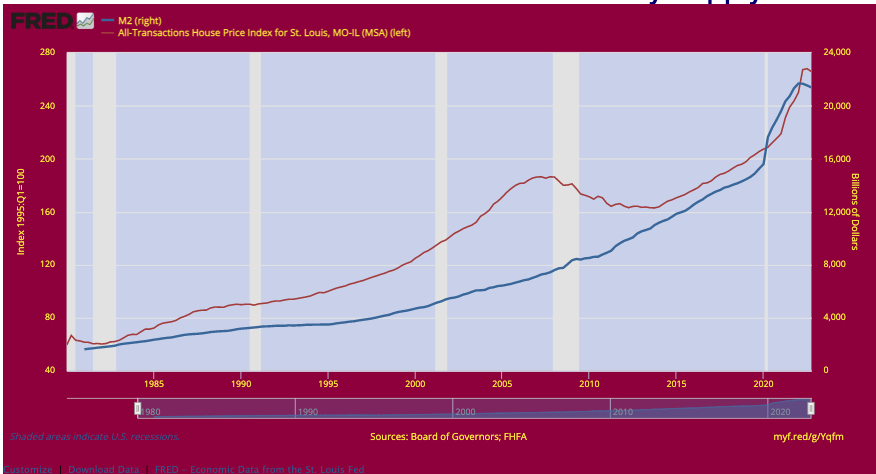
St Louis Home Prices vs M2 Money Supply

Federal Funds Target Rates (Upper and Lower Limits) vs 30 Year Fixed Rate Mortgage Rates

(click on chart for live, interactive chart)
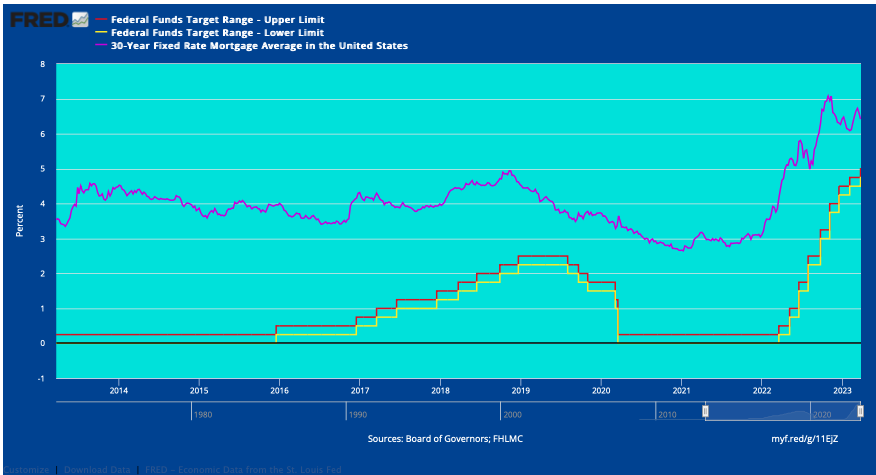
Federal Funds Target Rates (Upper and Lower Limits) vs 30 Year Fixed Rate Mortgage Rates


📬 Stay Ahead of the St Louis Market

Get local real estate updates, trends & insights — as soon as they publish.

Homeowners, buyers, investors & agents rely on us for what really matters in STL real estate.

We don’t spam! Read our privacy policy for more info.

📬 Want St Louis real estate updates as they drop?

Comments are closed.

St Louis Real Estate Search®         St Louis Home Values

St. Louis Real Estate News        Contact Us

Copyright © 2026 Missouri Online Real Estate, Inc. - All Rights Reserved
St Louis Real Estate News is a Trademark of Missouri Online Real Estate, Inc.

Missouri Online Real Estate, Inc. 3636 South Geyer Road - Suite 100, St Louis, MO 63127 314-414-6000 - Licensed Real Estate Broker in Missouri

The owner and authors this site are providing the information on this web site for general informational purposes only and make no representations, warranties (expressed or implied) or guarantees of any kind whatsoever, as to the accuracy or completeness of any information on this site or of any information found by following any link on this site. Furthermore, the owner and authors of this site will not be liable in any manner whatsoever for any errors or omissions in information on this site, nor for the availability of this information. Additionally the owner and authors of this site will not be liable for for any losses, injuries or damages in any way from the display or use of this information or as the result of following external links displayed on this site, or by responding to advertisements displayed, or contained, on this site In using this site, users acknowledge and agree that the information on this site does not constitute the provision of legal advice, tax advice, accounting services, investment advice, or professional consulting of any kind nor should it be construed as such. The information provided herein should not be used as a substitute for consultation with professional tax, accounting, legal, or other competent advisers. Before making any decision or taking any action on this information, you should consult a qualified professional adviser to whom you have provided all of the facts applicable to your particular situation or question. None of the tax information on this web site is intended to be used nor can it be used by any taxpayer, for the purpose of avoiding penalties that may be imposed on the taxpayer.
All of the information on this site is provided as is, with no assurance or guarantee of completeness, accuracy, or timeliness of the information, and without warranty of any kind, express or implied, including but not limited to warranties of performance, merchantability, and fitness for a particular purpose.
This site contains external links to other sites not owned or controlled by the owner of this site, therefore the owner of this site does not control or guarantee in any manner the accuracy or relevancy of any information obtained through following such links. Links contained on this site are for users convenience and users should exercise extreme caution when following links. Including a link on this site does not constitute an endorsement of the site linked to or any views or opinions expressed on the site, products or services offered on outside sites or the companies or organizations that own and operate outside sites.
This site may accept payment for advertising, for displaying advertisements, through affiliate relationships with companies or may receive referral fees or commissions from companies as a result of recommending or referring people to a website. This site may also accept free product samples, free services, gift cards or cash to review a product or service. All paid and sponsored content may not always be identified as such. Any product claim, quote or other representation about a product or service should be verified with the manufacturer or provider.

Do the Fed Funds rate and M2 money supply really matter to the St Louis real estate market?

By , on March 25th, 2023

For the past several months there have been many reports anticipating the moves of the Federal Reserve regarding interest rates then followed by tons of articles, blog posts and videos analyzing then predicting the impact of the Fed’s decision on the economy.  The other popular topic in this area is the “Money Supply”, usually M2 money supply and whether it’s increasing or decreasing as well as the impact on the economy.

Should St Louis homeowners and potential home buyers really care about the Fed Funds rate or M2 money supply?

First, let’s talk about the Fed Funds rate and what it is, what it is intended to do and the affect it can have on the real estate market.  The Fed Funds rate is the interest rate at which banks lend to each other overnight to maintain their reserve requirements. This rate is set by the Federal Reserve, and changes to the rate can have a ripple effect throughout the economy, including the mortgage and housing markets. When the Fed lowers the Fed Funds rate, it can stimulate economic growth by making it cheaper for banks to borrow money, which can lead to lower mortgage interest rates. Lower mortgage rates make it more affordable for homebuyers to finance their purchases, which can increase demand for homes and drive up prices. Conversely, when the Fed raises the Fed Funds rate, it can lead to higher mortgage interest rates, which can slow down the housing market and lead to lower demand and prices.

Next, the the M2 money supply.  The M2 money supply includes cash, checking accounts, savings accounts, and other liquid assets that can be easily converted into cash. When the M2 money supply increases, it can stimulate economic activity by making more money available for borrowing and spending. This can lead to lower mortgage interest rates as well, as banks have more funds available to lend out. However, if the M2 money supply increases too rapidly, it can lead to inflation, which can cause mortgage interest rates to rise.

So, as you can see, both the Fed Funds rate and M2 money supply can have a significant impact on the cost of a home mortgage as well as home prices so I would say the answer to the question I posed is “yes”.  Granted, we don’t all need to become economists or stay up late at night pouring through spreadsheets and date, but to be aware of factors that affect the economy as a whole and as a result, the real estate market we’re in, would be wise.

How can knowledge of the Fed Funds rate and M2 money supply help me as a home seller or buyer?

The short answer is, it gives you a little insight into perhaps where things are headed which may help you make the decision to buy or sell sooner or later. For example, perhaps  you are contemplating buying an home but anguishing over the fact the mortgage interest rates are double what they were a year or two ago and you’re thinking maybe you should wait until things settle down.  Well, if you see the Fed Funds rate getting increased with talk of more increases while that is no guarantee mortgage interest rates will increase as well, as I explained above, it’s certainly an indicator that is a likelihood.  Therefore, you may decide it’s better to make a move now than later.

What’s an easy way to track this stuff?

I have the answer for you.  The charts below are two of the many charts and other information available on St Louis Real Estate Search as well as from MORE, REALTORS® .  The first chart shows the relationship historically between St Louis home prices and the M2 Money Supply.  Generally, they follow the same trend but, when the trend for one changes, like it did with St Louis home prices (the red line on the chart) beginning in the late 90’s through the housing market bubble burst after 2006, something happens to bring them back in line.  As you can see, starting a little over 3 years ago the pace at which M2 was growing outpaced St Louis home prices, but St Louis home prices quickly caught up. Now it’s the opposite and it looks like both a making a downward correction.

The bottom chart shows the close relationship between the Fed Funds rate and mortgage interest rates.  With little exception, when the Fed Funds rate increases or decreases, mortgage rates follow. For the past year, the Fed Funds rate has increased and the trend is upward so I wouldn’t expect to see falling mortgage interest rates anytime soon.

Search St Louis Homes For Sale    Search St Louis Upcoming OPEN HOUSES

St Louis Home Prices vs M2 Money Supply

(click on chart for live, interactive chart)

St Louis Home Prices vs M2 Money Supply

Federal Funds Target Rates (Upper and Lower Limits) vs 30 Year Fixed Rate Mortgage Rates

(click on chart for live, interactive chart)

Federal Funds Target Rates (Upper and Lower Limits) vs 30 Year Fixed Rate Mortgage Rates

Search St Louis Homes For Sale    Search St Louis Upcoming OPEN HOUSES


Comments are closed.