Most people assume designing a home begins with a blank sheet of paper. In reality, long before an architect sketches the first floor plan or a builder estimates construction costs, every property is already constrained by rules that define the largest home the city will allow. Those rules apply whether you’re building a new home, planning an addition, or evaluating the redevelopment potential of an older property. The challenge is that most homeowners never see those limits, even though they influence nearly every significant building decision.
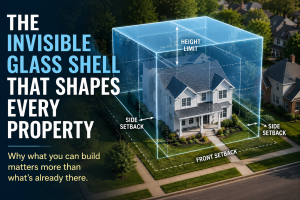
The easiest way to picture those limits is to imagine the city has quietly lowered an invisible glass shell over your lot. The shell isn’t something you can see standing in your yard, but it represents the maximum three-dimensional space a building may legally occupy under the local zoning code. Once you picture that shell, one of zoning’s most confusing concepts suddenly becomes much easier to understand.
Within that space, an architect has remarkable flexibility. A home might be a ranch, a two-story colonial, a modern design, or something completely custom. Rooms can be rearranged, rooflines can change, and floor plans can evolve in countless ways. The one constant is that every wall, porch, garage, dormer, roofline, and addition must fit within that invisible boundary.
Most discussions about zoning present homeowners with a long list of individual regulations. Setbacks determine how close a home may be built to a property line. Height restrictions limit how tall it can be. Lot coverage controls how much of the property may be occupied by structures, while stormwater requirements, easements, and other development standards create additional constraints. Read individually, those rules can feel technical and unrelated. Viewed together, they’re all doing the same job: defining the size and shape of the three-dimensional space available for a building. Planners call that space the building envelope.
Once you visualize the building envelope, many real estate questions suddenly have straightforward answers. Two homes may sit on lots that appear almost identical, yet one owner can build a larger addition than the other because the building envelopes are different. A builder may pay dramatically more for one tear-down than another because one property can accommodate a significantly larger replacement home. Even neighboring houses that look similar from the street may have been built under different zoning regulations, creating different opportunities decades later.
I was reminded of that earlier this year while listing an older home in Kirkwood. The sellers believed builders would likely pay a premium because several nearby homes had already been replaced with beautiful new construction selling for well over $1 million. At first glance, the assumption seemed reasonable. The neighborhood supported redevelopment, the lot appeared comparable to others nearby, and there was every reason to believe builders would reach similar conclusions.
They didn’t.
Once builders evaluated the property under today’s zoning regulations, they weren’t focused on the existing house as much as the future one. Current setback requirements, stormwater standards, and other development regulations limited the size of the replacement home that could legally be built. The lot itself hadn’t changed over the years, but the framework governing its future had. That difference changed the economics of the project and, ultimately, what builders were willing to pay.
That experience reinforced an important distinction between how homeowners and builders evaluate the same property. Homeowners naturally focus on what already exists. Builders focus on what the property can still become. Those are two very different calculations, and the difference is often determined long before construction begins.
Fortunately, most homeowners don’t need to become experts in zoning ordinances. But understanding the idea of a building envelope can make conversations about additions, tear-downs, redevelopment, and even property values much easier to understand. Instead of seeing zoning as a confusing collection of disconnected rules, you begin to see the framework those rules create and why professionals spend so much time studying it before making major decisions.
The next time you drive through Kirkwood, Webster Groves, Glendale, Clayton, Maplewood, Brentwood, Florissant, Bridgeton, or almost any established St. Louis community, you’ll probably notice older homes standing beside much larger new construction. From the street, those differences can seem arbitrary. In reality, every one of those properties has a building envelope that quietly shapes what can happen there in the future. You may never see it with your own eyes, but once you understand that invisible framework, you’ll never look at a piece of property quite the same way again.

Karen Moeller
STLKaren.com
Karen.McNeill@STLRE.com
314.678.7866
About the Author:
Karen Moeller is a St. Louis area REALTOR® with MORE, REALTORS® and a regular contributor to St. Louis Real Estate News, helping clients make informed, data-driven decisions.