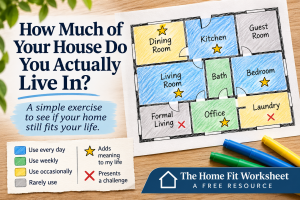
If you were to color-code the rooms in your house according to how frequently you use them, what would your floor plan look like? How different might it have looked five, ten or twenty years ago?
I’ve created a free Home Fit Worksheet to help you explore those questions. You’ll need a pencil, a few colored markers and a little time to think about how you actually live in your home. You might be surprised by what you discover.
When we purchase a house, we generally do so with a particular version of our lives in mind. We may need bedrooms for children, a dining room large enough to accommodate extended family or a finished basement where teenagers can gather with their friends. Over time, the circumstances that influenced those decisions may change considerably, even though the house remains much the same.
Of course, how frequently we use a room doesn’t necessarily tell us how much we value it. A dining room that sits empty most of the year may be the heart of every family holiday. A guest bedroom may only be occupied a few weeks each year, but having a place for your grandchildren to stay might be something you wouldn’t willingly give up.
That’s why the worksheet goes beyond measuring how frequently you use each room. It also asks you to identify the spaces that add something meaningful to your life and those that regularly present a challenge.
Perhaps your laundry room is two flights of stairs away from your bedroom, your garage is too narrow to comfortably get in and out of your car or your kitchen makes it nearly impossible for two people to prepare a meal together. You may find that some of the rooms you use most frequently are also the ones that cause you the most frustration.
If you share your home with someone, I encourage you to complete separate worksheets and compare your answers. That seldom-used formal living room you would happily sacrifice may be the one place your spouse can retreat with a good book and enjoy some uninterrupted time. You may discover that you have very different ideas about which features of your home are worth preserving.
There are no right or wrong answers to this exercise. Having more space than you strictly need isn’t a problem in itself, and there is no reason to feel obligated to give up something you enjoy simply because you don’t use it every day.
Perhaps the most revealing part of the exercise is identifying what your floor plan doesn’t show. You might have four bedrooms but nowhere comfortable to work from home. You may have a beautiful finished basement but wish you had more living space on the main level. What would you add to your floor plan if you could?
Before concluding that you need a different house, consider whether you’ve simply fallen into the habit of using your current one a certain way. Rooms don’t have to retain the purposes assigned to them by a builder or a previous owner. An unused dining room might make a wonderful library, and a former child’s bedroom might accommodate a hobby you’ve always wanted to pursue.
If you do find yourself contemplating a move, resist the temptation to assume that a smaller house will necessarily be less expensive. Replacement housing, financing, taxes, association fees and moving expenses all deserve consideration. Finding a better fit might involve less square footage, more square footage or simply a different arrangement of the same amount of space.
We tend to put considerable thought into whether a house fits our lives when we’re shopping for one. Once we move in, we may spend years adapting our lives to the house without ever revisiting that original decision.
When you’ve completed your worksheet, imagine walking through your own front door as a prospective buyer. Knowing what you know now about how you actually live, would you choose this house again? If not, what would you choose differently?

Karen Moeller
STLKaren.com
Karen.McNeill@stlre.com
314.678.7866
About the Author:
Karen Moeller is a St. Louis area REALTOR® with MORE, REALTORS® and a regular contributor to St. Louis Real Estate News, helping clients make informed, data-driven decisions.