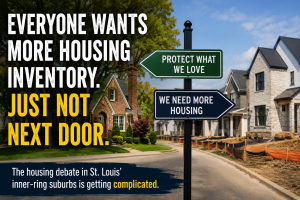
Everyone agrees St. Louis needs more housing inventory.
Until somebody actually tries to build it.
That tension is quietly shaping conversations across St. Louis County right now, especially in established inner-ring suburbs like Kirkwood, Webster Groves, Des Peres, and Sunset Hills, where demand remains strong, available land is limited, and nearly every new development proposal comes with competing opinions about what growth should look like.
The conversation resurfaced again recently as multiple residential developments continue moving forward in Sunset Hills, including projects like Manors at Lynstone Park, Gates Manor, Sunset Reserve, and Vistas at Stone Castle.
On the surface, these are simply new subdivisions. Underneath, however, is a much larger question facing established suburbs across the country:
Where exactly is new housing supposed to go?
For years, buyers across the St. Louis area have been dealing with low inventory, rising prices, and intense competition for desirable homes. In highly sought-after communities, buyers often complain there is “nothing available.” At the same time, many of those same communities are largely built out.
There are only so many vacant lots left in places like Kirkwood or Webster Groves. Infill opportunities are limited. Redevelopment can become politically contentious quickly. Even relatively small projects can spark heated conversations about traffic, stormwater runoff, school crowding, tree loss, parking, or neighborhood character.
In some neighborhoods, a single teardown can spark weeks of debate about traffic, trees, parking, stormwater runoff, and whether the community is slowly becoming unrecognizable.
And to be fair, some of those concerns are legitimate. Growth is not free. Infrastructure, drainage, roads, and municipal services all matter, and residents who have spent decades building lives in these communities understandably care what future development looks like.
But the math problem underneath the conversation is becoming increasingly difficult to ignore.
Many inner-ring suburbs are caught between two competing realities: people want housing affordability, but they also want to preserve the exact characteristics that make these communities desirable in the first place.
Those goals do not always align neatly.
Many communities say they want housing affordability, but affordability almost always requires some form of change. More density. Smaller lots. Redevelopment. Mixed-use projects. Townhomes. Condos. Or new construction in places residents may not have expected it.
The challenge becomes especially visible when older homes are torn down and replaced with significantly larger new construction.
To longtime residents, teardowns can feel like erosion of neighborhood identity. To buyers, they may represent one of the few opportunities to get newer housing in highly desirable areas. To municipalities, they often increase taxable value.
All three perspectives can exist at the same time.
Construction costs add another layer of complexity. Even when municipalities support new housing, building smaller, entry-level homes has become increasingly difficult financially. Land costs, labor costs, material costs, permitting expenses, stormwater requirements, and infrastructure upgrades all push builders toward higher price points simply to make projects viable.
That reality is one reason many buyers searching for “starter homes” in highly desirable suburbs increasingly discover that true entry-level inventory barely exists anymore.
At the same time, many inner-ring suburbs are also experiencing generational transition as longtime homeowners age out of homes they have occupied for decades. In some cases, homes that remain in the same family for generations eventually become teardown opportunities simply because the underlying land has become more valuable than the structure sitting on it.
The issue is not unique to St. Louis. Nationally, communities are wrestling with the same debates surrounding density, redevelopment, zoning, affordability, and growth. Some cities are pushing for more aggressive housing expansion. Others are tightening restrictions after backlash from residents concerned about overdevelopment. Most suburbs are trying to walk an increasingly narrow line somewhere in the middle.
And that balancing act is becoming harder.
Buyers want more inventory.
Homeowners want their property values protected. For many people, especially those nearing retirement, their home represents a significant portion of their long-term financial security.
Residents want neighborhood charm preserved.
Municipalities want economic stability and sustainable tax bases.
Nobody wants worsening traffic.
Everybody wants affordability.
Those priorities often collide in the exact same public meeting.
That is why housing conversations have become so emotionally charged in many established suburbs. The debate is rarely just about one subdivision or one development proposal. It is about competing visions for what a community should become over the next twenty years.
Should growth remain slow and highly controlled, even if prices continue rising?
Should density increase in certain areas?
Should older commercial properties be redeveloped into residential housing?
Should municipalities encourage smaller homes, townhomes, or mixed-use developments?
None of those questions have simple answers, especially in communities where residents care deeply about preserving what they already love about where they live.
But one reality is becoming increasingly clear.
It is easy to say a community needs more housing.
The harder question is what residents are actually willing to change in order to create it.
And in many of St. Louis County’s most desirable suburbs, that conversation is no longer theoretical. It is already happening.

Karen Moeller
STLKaren.com
Karen.McNeill@STLRE.com
314.678.7866
About the Author:
Karen Moeller is a St. Louis area REALTOR® with MORE, REALTORS® and a regular contributor to St. Louis Real Estate News, helping clients make informed, data-driven decisions.
