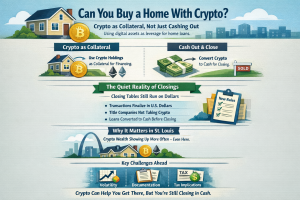
For years, the answer has technically been yes, but practically no. Not in the way people imagined.
You could sell your crypto, convert it to dollars, and buy a home. That part was never the issue. The idea of showing up to closing and transferring cryptocurrency directly to a seller has remained more headline than reality. What has changed recently is not the transaction itself. It is what sits behind it, and that shift is worth paying attention to.
The Old Way: Convert then Buy
Up until now, using crypto in a real estate transaction has followed a predictable path. The buyer liquidates their cryptocurrency, moves the funds into a bank account, and proceeds like any other cash buyer or financed borrower. From a lending and title perspective, nothing else really works. Lenders need documented, seasoned funds. Title companies need clear, verifiable sources of money. Underwriters are not in the business of tracking digital wallets across a blockchain. So crypto has functioned as a source of funds, not a form of payment.
What Is Changing: Crypto Is Entering the Mortgage Conversation
This is where things start to shift. We are beginning to see early-stage programs that allow buyers to use cryptocurrency not just as something to sell, but as something to leverage. These programs are still limited and not widely available, but they represent a change in how digital assets are being viewed within the lending space.
In simple terms, instead of liquidating crypto to buy a home, some buyers may be able to keep their holdings intact and use those assets as collateral to obtain financing. That is a very different conversation than cashing out and closing.
It also signals something larger. When products begin to align with institutions tied to the conventional mortgage system, it is no longer theoretical. It is moving toward broader adoption, even if slowly.
The Quiet Reality: Closing Tables Still Run on Dollars
Before this gets overhyped, it is important to stay grounded in what is actually happening in real transactions. Closings are still conducted in U.S. dollars. Title companies are not accepting cryptocurrency in place of wired funds. Lenders are not underwriting loans based on unconverted digital assets sitting in a wallet.
Even in transactions where crypto plays a role, there is almost always a conversion step or a structured approach that results in dollars by the time the deal closes. So if a buyer asks whether they can buy a home with crypto, the honest answer is crypto can help you get there, but you are still closing in cash.
The Regulatory Layer Is Catching Up
Another shift happening in the background is regulation. Beginning in 2026, certain transactions involving digital assets will fall under expanded reporting requirements. That includes reporting the fair market value of crypto used in a transaction and increased scrutiny around sourcing and documenting those funds.
These requirements primarily impact financial intermediaries and settlement professionals, but they are another signal that regulators expect digital assets to show up more often in real-world transactions. This is not about restricting use. It is about tracking it.
Where Deals Can Get Complicated
From a practical standpoint, there are still real challenges. Volatility is the most obvious. A contract price agreed upon today can look very different if the underlying asset swings before closing.
Documentation is another. Being able to clearly show where funds came from, how they moved, and that they meet lending and compliance standards is critical.
There is also the tax component. Converting cryptocurrency into dollars is typically a taxable event. Buyers who are not planning for that can run into issues at the worst possible time.
For most buyers, converting to cash early remains the most predictable and least complicated path.
Why This Matters in St. Louis
It would be easy to dismiss this as something happening only in larger coastal markets. That would be a mistake. You may not be seeing this in everyday transactions in St. Louis yet, but buyers showing up with wealth tied to digital assets is no longer unusual. Even if you never plan to use cryptocurrency directly, you may encounter it through a buyer, a co-buyer, or funds being used in a transaction. What tends to appear in niche or higher-end deals first often works its way into broader markets over time.
In this case, the takeaway is not that homes in St. Louis will suddenly be purchased with Bitcoin. It is that more buyers will expect to use crypto as part of their financial profile, and those transactions will need to be structured correctly.
The Bottom Line
We are not moving toward a world where homes are commonly bought with cryptocurrency at the closing table. We are moving toward a world where digital assets are increasingly recognized as part of a buyer’s overall financial picture. That is a quieter shift, but a more important one.
The buyers who understand this early will have more flexibility. The agents who understand it will avoid delays, documentation issues, and last-minute surprises.

Karen Moeller
STLKaren.com
Karen.McNeill@STLRE.com
314.678.7866
About the Author:
Karen Moeller is a St. Louis area REALTOR® with MORE, REALTORS® and a regular contributor to St. Louis Real Estate News, helping clients make informed, data-driven decisions.




tadalafil versus viagra
tadalafil versus viagra
vidalista black 80 australia
vidalista black 80 australia
vidalista 60 iskustva
vidalista 60 iskustva
domperidone goodrx
domperidone goodrx
doxycycline monohydrate for women
doxycycline monohydrate for women
doxycycline hyclate rx
doxycycline hyclate rx
metronidazole flagyl price
metronidazole flagyl price
tadalafil tablet sizes
tadalafil tablet sizes
what is ketoconazole cream
what is ketoconazole cream
terbinafine dosage information
terbinafine dosage information
ketorolac tromethamine nsaid
ketorolac tromethamine nsaid
toradol pain relief instructions
toradol pain relief instructions
avanafil online safety notes
avanafil online safety notes
amoxicillin pharmacology
amoxicillin pharmacology