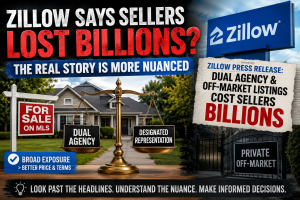
Zillow dropped a new press release this week claiming home sellers lost billions from dual agency and off market listings and, as expected, the headlines were designed to make it sound like the sky is falling. The actual data, however, tells a much more nuanced story than the press release would lead consumers to believe.
First, let me be clear, I have never been a fan of true dual agency where one agent attempts to represent both buyer and seller equally. In my opinion, that arrangement creates inherent conflicts and probably should not even be legal. But what Zillow conveniently blurs together in its release is the difference between dual agency and designated representation where the listing agent represents the seller only while working directly with an unrepresented buyer who fully understands the situation and consents to it.
Those are two very different things.
There are plenty of buyers who are perfectly comfortable dealing directly with the listing agent, especially experienced buyers who simply want accurate information straight from the source and do not necessarily want or need separate representation. As long as disclosures are handled properly and the buyer clearly understands the listing agent represents the seller and owes fiduciary duties to the seller, those transactions can work very well for everyone involved.
The same goes for the off market debate. One of the biggest justifications always given for private or off MLS listings is seller privacy. We constantly hear examples involving celebrities, billionaires, executives, professional athletes, or people trying to quietly sell a $50 million estate without public attention. The problem is that, at least here in the St. Louis market, those situations are extremely rare. We are not Beverly Hills and we are not exactly overflowing with celebrities hiding behind gates trying to secretly unload mansions from paparazzi.
That is why I think consumers and agents should look past the headlines and really ask what is driving many of these off market strategies. In most cases, broad exposure to the market through the MLS will still produce the best opportunity for sellers to maximize price and terms. That has been true for decades and probably still is today. At the same time, not every off market transaction is unethical or harmful either. There are legitimate situations where it makes sense. My issue is when broad policy arguments get built around privacy scenarios that, in reality, represent a tiny fraction of what actually happens in markets like St. Louis.
What Zillow is really doing here is advancing its own business interests while wrapping the message in consumer protection language. Zillow depends heavily on broad MLS exposure and maximum public visibility of listings. Private networks and office exclusives are a threat to that model, so naturally Zillow is going to push hard in the opposite direction.
There is probably truth in some of the data Zillow presented. More exposure generally helps sellers. But consumers and agents should look beyond the dramatic headlines and understand there is a lot more nuance here than the press release suggests.